Saturday, August 15, 2015

Glacier, Nine-pipe and Bison

Bob's Gone Birding at National Bison Range
Glacier National Park

Lake MacDonald in Glacier National Park
As soon as I opened the door to my hotel room, I felt a foreboding.  Cold and wet, that's not my favorite kind of morning.  The "breakfast" in the lobby was another disappointment.  Coffee and some rolls.  I took some coffee and left the rolls in peace.  The rain picked up as I drove the last 12 miles to the park.  I pulled up to the gate to show my National Parks Senior Pass and was greeted by a ranger.

"You can go ahead.  Need a map? And the road is closed about 20 miles ahead.  There's a fire on the eastern side, so Logan Pass is closed."

Logan Pass was closed.  I had come to Glacier National Park from Florida to bird the Logan Pass area, and it was closed.  Still, I had nearly three days to bird one of the world's most beautiful places.  There was a lot to do and ground to cover, so I started up the road. 

On birding trips far from home, you have to be flexible.  Since I couldn't go to the top, I decided to start at the bottom and bird my way up the mountain as far as possible.  Maybe I could reach the Loop Trail and hike that, but on the way I would check out the Lake MacDonald area.  Good plan.

Song Sparrow near Mineral Creek
Lake MacDonald (above, right) is spectacular.  Ten miles long, about a mile wide, and about 500 feet deep, it's as beautiful a lake as you are ever likely to see.  But there were no birds on it that I could see.  For mile after mile I kept glancing at the lake to no avail.  Eventually I reached the lodge and pulled into the parking lot.

I was greeted by swarms of swallows above the lodge.  Many were Barn Swallows, but I saw a few bright white foreheads of Cliff Swallows.  There may have been others, but looking up at them through binoculars in the rain was a challenge.  Then I heard the familiar call of a Swainson's Thrush.  It wasn't hard to track it down, and I got some nice looks.

The rain continued to be a problem, so I made an impromptu decision to go into the lodge and have breakfast.  Now THAT was a breakfast buffet!  The food was excellent including some really tasty breakfast bison-antelope-elk sausage, French toast, 7-grain flapjacks, fresh fruit, and more.  I ate like a mad man, and despite the $15 price, I think they lost money on me.

Outside the rain had finally stopped and the day had warmed a bit.  I drove farther up the road until I reached a pull-off area.  Mineral Creek lined the north side of the road while a small pond graced the south.  This looked like a promising spot, and it turned out to be the best birding of the day.  First there was a Mountain Chickadee in the pines along the creek.  Then a Song Sparrow fed along a pile of logs on the water's edge.  That was followed by a brilliant flash of yellow and red - a gorgeous male Western Tanager in all its beauty.

Western Tanager
I walked over to small pond and was immediately rewarded with a blur of brown passing overhead.  I tracked it and thought, that's not a swallow.  Chimney Swift?  I checked the range map; no Chimney Swifts were in Glacier, but there were Vaux's Swifts!  I waited patiently and the bird soon came back with several friends - Vaux's Swifts to be sure!  I had only seen one other in my life and that was at a distance.  This was a very close and satisfying view.  It may not have been a lifer, but it felt like one.

I stayed in the area longer and watched Yellow Warblers skitter through dense brush.  A Red-naped Sapsucker hung out on a tall snag.  Cedar Waxwings seemed to be everywhere, and I never tire of looking at them.  A female Mallard and her children made a brief appearance at the back of the pond, and American Robins called raucously as they passed though the area.

This was really fun birding, but there was one downside.  I was birding along the only road in this part of the park, and it was jammed with traffic.  Red buses, groups of motorcycles, and an endless stream of cars flowed both up and down the road.  The noise was constant, and as more and more people decided to stop and check out this pretty little spot, the area began to feel crowded.  Eventually I decided to move on up the mountain.  The morning was passing and there was still a lot of territory to cover.

Mineral Creek, Glacier National Park
The rest of my time in Glacier National Park lasted more than a day and a half, but unfortunately it is very brief in the telling.  I drove all the way to the Weeping Wall, passing one filled parking lot after another.  With no room to stop, I kept moving up.  Even the parking area at the Big Bend near the Loop Trail was filled.  Finally I stopped at the Weeping Wall parking area where I set up my spotting scope and waited patiently as a long line of people looked through it at a white dot that was a Mountain Goat.  I saw one bird, but it was too far away to identify.  Back down the mountain I stopped again at the site where there were so many birds in the morning.  Most were still there, and some Violet-green Swallows had joined the party.  As evening approached I turned into a very crowded Apgar Village and was pleased to see a few White-collared Swifts.

My second day in the park was less successful in birding terms, but still very enjoyable.  This time both Logan Pass and the Big Bend were closed, so I couldn't hike either the Loop Trail or Logan Pass, and that ended any hope for some real alpine birding.  Instead, I hiked along Avalanche Creek where I was thrilled to find two American Dippers.  Then I made the three-mile climb to Avalanche Lake, gaining about 500 feet in elevation and dodging an endless crowd of hikers along the way.  I had heard there were Bohemian Waxwings and a loon up there.  What I found were Canada Geese, a Robin, some Vaux's Swifts, and a single Common Goldeneye.  Later I ate some pizza while watching the Columbian Ground Squirrels play on the lawn near the Lodge at Lake MacDonald, but I found no more birds.

Nine-pipe and National Bison Range 
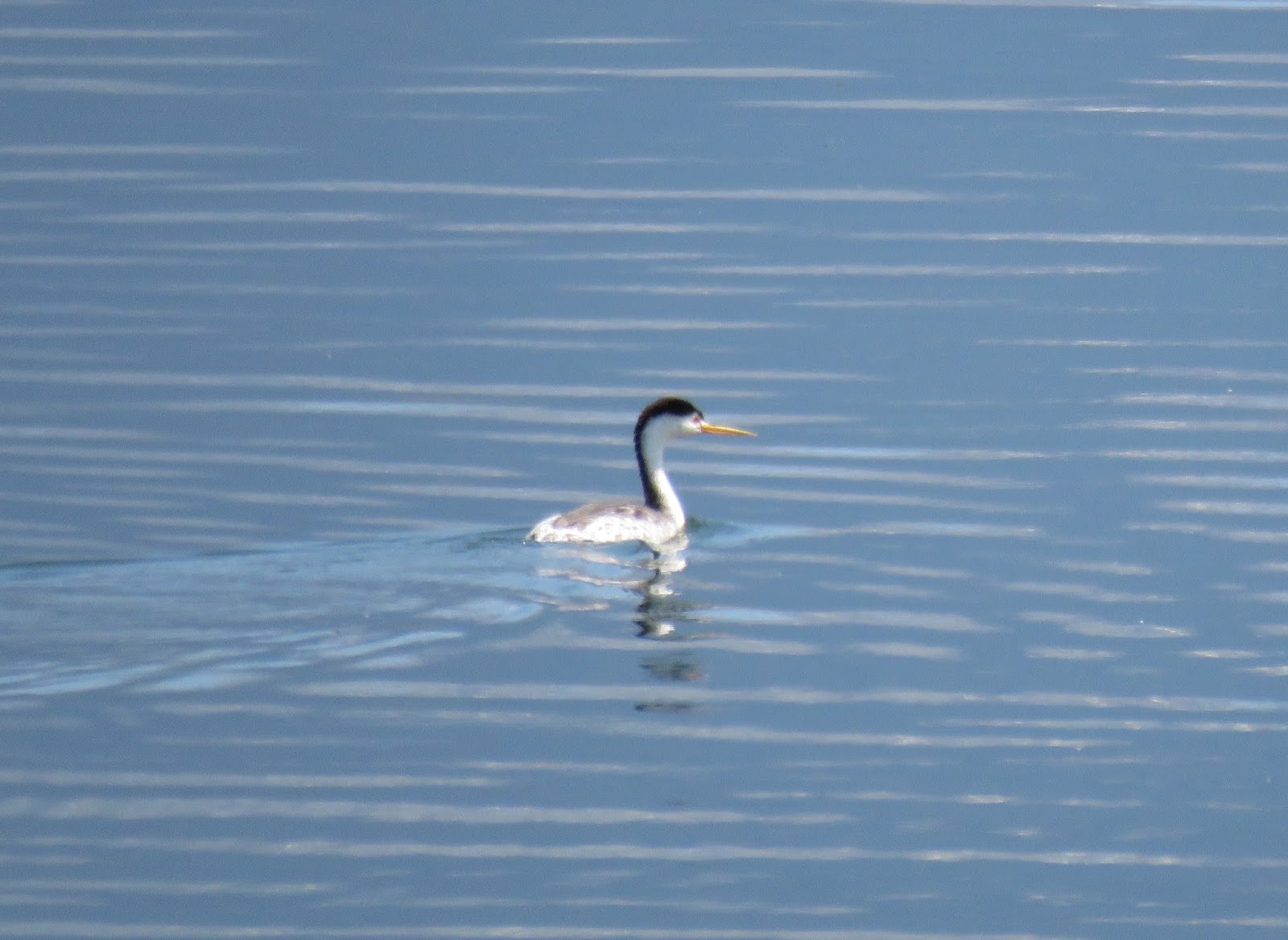
Bad photo, but great bird - Clark's Grebe!
In two full days of birding in Glacier, I found only 19 species.  Yes, there were some really great birds, but very few of them.  So instead of returning to Glacier where the fire still had the road closed, I decided to go with Plan B.  I left Columbia Falls and turned south where I planned to search Nine-pipe NWR for some waterfowl and then take the wildlife drive at National Bison Range.

Before I even reached Nine-pipe, I saw a large pond on the west side of the road.  I pulled off across the street into a parking area with a historical marker describing the Mission Mountains.  Beyond it was a smaller pond that was teeming with life.  Cedar Waxwings and Cliff Swallows decorated the sky while Spotted Sandpipers, Killdeers, Black-necked Stilts, Greater Yellowlegs and a Long-billed Dowitcher grazed along the edge of the water.  On the pond were a Northern Shoveler, several American Coots and a group of what I believe were Lesser Scaup.  Across the highway there was more to be seen, but the distance made identifications difficult.  I saw Red-winged Blackbirds and a couple of Trumpeter Swans.

An American Bison
The ponds and potholes in Nine-pipe were equally productive.  Eastern Kingbirds seemed to be everywhere.  The large lake at the dam held hundreds of birds, but again distances and heat waves made viewing a challenge.  I saw one bird that really, really looked like a Red-breasted Merganser. but range maps suggest that the species shouldn't be in the area.  After some thought, my best guess is that it was a female Common Merganser and the bill only appeared to be longer in the shimmering heat.  There were a few Ruddy Ducks, lots of Canada Geese, and a few red-necked Grebes.  Then I saw two white birds swimming comparatively close to the dam.  I put my scope on one and saw a Western Grebe.  Excellent ... but not the grebe I was hoping for.  I swung to the other bird and waited until it turned its profile to me.  And there, entirely surrounded by white, was the brilliant red eye of a Clark's Grebe - a lifer and one of the prime targets of the trip.  I celebrated briefly, then got the scope back on the bird and watched it for a while.  Then I remembered I had a camera!  As the bird increased its distance I tried several times to get that diagnostic eye-in-the-white photo.  The shot I got wasn't the best, but it will do!

An elk taking a sip of water
Next I was on to National Bison Range.  While the birding wasn't spectacular, the landscape and the bison herds were.  Teddy Roosevelt was instrumental in establishing the park in 1908, and today the herd numbers close to 500.  It's managed through an annual roundup in which surplus animals are sold live - not hunted and killed.  Except in a few well-marked places, it is forbidden - and very unwise - to wander away from your car along the Red Sleep Mountain drive.  So nearly all of the birding was through car windows.  Still, I saw Western Meadowlark, Eastern Kingbird, Western Wood-Pewee, Warbling Vireo, Black-capped Chickadee, and American Kestrel.  Along one short trail I saw Lewis's and Downy Woodpeckers, Northern Flicker and Red-tailed Hawk.  Back in the car, I added Mountain Bluebird and Swainson's Thrush to the day's total.  There was also a real treat along Mission Creek where deer and elk walked in the clear, cold water.

Finally I left the park to make the long, long trek to Salmon, Idaho, crossing Chief Joseph Pass in the dark on yet another white-knuckle drive.  As I drove, I reflected on the day.  I had 38 species including one lifer.  This was exactly double the number I had in two days in Glacier.  And I had seen herds of 50-60 bison grazing on the hillsides.  I had no idea what the Salmon area had to offer, but I wondered if it could possibly top this day?

In a word, yes!
 
I hiked 3 miles and up 500 feet to reach Avalanche Lake and the first bird I saw was a Robin - a winter resident at home.
Avalanche Lake.  The water is so clear you can't tell that it almost reached to the boulder in the foreground.
Columbian Ground Squirrel near Lake MacDonald, Glacier National Park
A mural covering the front of a building in Columbia Falls
Western Wood-Pewee at National Bison Range
A fawn enjoying Mission Creek.  Its mom was nearby.

Saturday, August 8, 2015

Coeur D'Alene to Columbia Falls

The Clearwater River at Nez Perce National Historic Park

Nez Perce Rangers Erecting a Tepee
The second day of my trip promised to be a sizzler.  Local weather reporters predicted highs above 100 "with the chance of a few clouds passing through in the afternoon."  Undaunted, I pulled into Nez Perce National Historic Park in Spalding, Idaho, and encountered something I rarely see at such a beautiful place - an empty parking lot.

I hopped out of the car and was immediately buffeted by a stiff breeze.  I birded around the edge of the lot for a while and was rewarded with a nice little mixed flock of birds in the greenery just below where I was standing.  A flock of American Robins seemed to be playing Follow the Leader as they sprinted from one spot to another feeding on berries and calling raucously to each other.  I saw a quick flash of yellow and tried to follow its mad dash through a series of bushes.  Then there was a second flash of yellow.  One, I'm sure, was a Yellow Warbler but the other might have been a Wilson's.  I didn't get a good enough look at it, so despite the temptation, I didn't add it to my day list.  Then a familiar, harsh, rattling sound caught my attention as a Belted Kingfisher flew over my head and moved east along the river.  It was a nice start to the day.

"Red-shafted" Northern Flicker
The picnic area at Nez Perce NHP is gorgeous!  It's nestled under a mostly pine canopy that provides plenty of cover for meals in the shade, and some open space for play in the sun.  An ancient cemetery rests in one corner and the ruins of a building in another.  Here, late in November, 1839, Henry Spalding established the first mission to the Nez Perce and built what is thought to be the first white man's home in Idaho.  He Baptized many tribal leaders, taught them to irrigate fields and grow potatoes, brought the first printing press to the area, developed a written language for the Nez Perce, translated the Book of Matthew, printed it, and distributed copies among his parishioners.  He and his wife Eliza were remarkable people and their memory is still respected by the Nez Perce and preserved in their park.

The birding here was pretty good.  A Northern Flicker perched in a snag showing off the red in his tail.  Our Flicker is yellow, of course, so I enjoyed seeing the red.  A group of flycatchers fed on invisible bugs and happily displayed their aerial agility.  I could only identify a Western Wood-Pewee with any degree of confidence, but I suspect I missed a life bird somewhere in those trees.

An "Audubon's" Yellow-rumped Warbler was a special treat and proved how beautiful that species can be.  The washed-out version we see in Florida bears little resemblance to this really pretty bird.  And when the Yellow-rumps start to look good, they leave.  A Lesser Goldfinch was another treat, showing off its black and gold to full advantage.

Yellow Warbler Peeking at Me
I tried really hard to turn a Red-eyed Vireo into something else, but truth won out.  A Calliope Hummingbird investigated the park ranger's yellow and green cart, but eventually lost interest and flew off.  A Red-tailed Hawk hung around for a while, and a few Cedar Waxwings flitted about.  I searched through them to no avail hoping for one of their Bohemian cousins.  A little later I descended a small bank and walked to the water's edge.  I was stunned at how significantly the temperature dropped as I approached the river.  The water was very cold, and the air around it much cooler than that in the picnic area 20 yards away.  As I enjoyed the cool air I noticed a Yellow warbler peeking at me through the bushes.  It was nice enough to pose for a photo or two, but never gave a me a clean look.

Before leaving the park, I decide to try one more trail.  It was a mile-long loop with little shade, and the temperatures were nearing the century mark.  I debated for a bit, but curiosity won out.  I was rewarded with a distant look at a Western Kingbird and later, a bench in the shade.  As I sat there sipping some water, I heard an unfamiliar song above me.  At first, I thought it was a House Finch, but the song was wrong.  I hear House Finches every day, and this was wrong.  I looked more closely - Cassin's Finch!  A lifer!!  What a terrific way to end a very enjoyable birding day.

My Cassin's Finch Lifer!
 I spent that night in Coeur D'Alene.  The next morning I wanted to get an early start.  I knew it was going to be a very long day.  I had an ambitious birding plan.  The first stop was to be at Farragut State Park on the southern tip of Lake Pend Oreille before moving on to Sandpoint and Denton Slough on the lake's north and eastern sides.  Finally I would have to reach my hotel in Columbia Falls, Montana.  Point-to-point driving would be about 400 miles and birding mileage would get me very close to 500 miles for the day.  Unfortunately, the day would prove to be more exhausting than productive.

Lake Pend Oreille from Farragut State Park
Farragut State Park is really gorgeous, but I found very few birds.  A Calliope Hummingbird and a Black-capped Chickadee were enjoying an early morning breakfast outside the headquarters building, and that proved to be the best birding of the morning.  Near the lake, a sparrow was being a bit elusive, hiding in a brushy area along a very narrow foot path.  As I tried to get a decent look, a person on a bike suddenly clamored down the stairs.  The bird flew off, never to be seen again.  I do not mind stepping aside for mountain bikers if I'm on open access trail.  But this was a foot path with a narrow set of stairs.  He had no business being there, and I lost a good bird.  A Catbird popped up a little later, but that was it.  Later I chased a group of finches feeding along the road, but they were very skittish, flying off if I got too close and at the sound of every approaching vehicle - and there were many.  I never did ID them.  I saw a Mountain Bluebird, some Brewer's Blackbirds, a Song Sparrow, and Ring-billed Gull, but that was it.

I'm pretty sure this is a California Gull.
Sandpoint was a really cute and quaint town with wonderful park and marina on the lake.  There were a lot of birds, but most of them were Canada Geese or Ring-billed Gulls.  Still, I enjoyed an hour or so walking around the place.  I enjoyed watching Cliff Swallows playing in the spray of a sprinkler system, and what proved to be a California Gull confused me for a bit.  I took a bunch of photos of it for later study.

Next I drove to the fish hatchery, a small but very productive stop.  Cedar Waxwings, Pine Siskins, and California Quails were seen in the first few minutes.  An Eastern Kingbird hunted along the water's edge and an Osprey soared overhead.  Unfortunately, I had hoped to see a Clark's Grebe in the area, but there were none, so I turned toward Denton Slough.  The drive along the eastern edge of the lake was picturesque, but not very productive.  The thousands of breeding ducks and grebes that are known to spend the spring here were already gone, leaving very few of their friends behind.  I saw a Bald Eagle, a Wood Duck, a Great Blue Heron and the ever-present Canada Geese.  Finally, at Denton Slough I saw a few interesting grebes.  They all turned out to be Western Grebes, great birds to be sure, but not what I was seeking.

Finally, I gave it up and made the five and a half hour drive to Columbia Falls.  I arrived really late at night, so I made a quick stop at an A&W restaurant for some food and a diet root beer.  They didn't have any.  The A&W Root Beer place didn't have any diet root beer.  Really?  Then my hotel room proved to be ... well ... disappointing.  Still, I was in the shadow of Glacier National Park where I planned to spend the next two and a half days!  I collapsed into bed and thought excitedly about the wonderful days to come.  Yes, I was counting up those chickens ... but would they hatch?
 
Western Wood-Pewee
Gray Catbirds spend the entire winter in my yard, and this was one of the few birds I identified in Farragut.

A Song Sparrow hiding in the shadows

An Eastern Kingbird at the Fish Hatchery in Sandpoint, Idaho

The Yellow Warbler shows me its other profile.


Wednesday, August 5, 2015

The Best Laid Plans

Seas of Wheat in the Palouse Area of Eastern Washington

The best laid schemes of mice and men
Go often askew,
And leave us nothing but grief and pain,
For promised joy!

From "To a Mouse" by Robert Burns 
Standard English Translation by "Simple English" Wikipedia

Western Wood-Pewee
Every birding trip I have taken has been carefully planned.  Many hours are spent on researching birding sites, driving routes, bird lists, range maps, airline fares, hotel rates ... all designed to get the most birds for the fewest bucks.  Usually things work out for the best despite a few pitfalls here and there.  I missed the Hook-billed Kite in Texas, but got the White-collared Seedeater and other great birds in the subsequent days.  A snow storm made travel over Santiam Pass quite treacherous and placed me at the Oregon coast much later than I planned.  But when I got there I immediately got four lifers within 15 minutes.  If I had been on time, I might have missed them.  Who knows?

Certainly no 10-day trip - even the most successful - is without its rough spots.  The best birding trip of my life was to Arizona where I tallied a huge number of life birds, but a much-desired birding location on Fort Huachuca was closed when I got there necessitating a significant change in plans.  And there was the birding trip of a lifetime to Alaska that was tempered by broken glasses and the saltwater assassination of my camera.

With all of that in mind, I was prepared for a few glitches in the road on my most recent excursion - nine days of non-stop birding in Washington, Idaho and Montana, the crowning jewel of which was to be two days in Glacier National Park, especially on the trails at Logan Pass searching for Ptarmigans, Rosy-Finches and Crossbills!  I had a list of 39 lifers that inhabited those states during the summer, but I recognized that I had a legitimate shot at less than half of them - say, 19.  So, if I got half of that group - 10 lifers - I'd be thrilled.  Overall, I expected to see about 120 species.

Canada Geese on the Snake River
Not so fast, my friends.  We all know about those best laid plans, and I was about to get an object lesson in patience.

The first issue to overcome was the State of Washington and everyone's favorite supercenter, Walmart.  You see, due to budgetary considerations, Washington does not have rangers in every park, at least not full time rangers who collect an entry fee.  No big deal; the same is true in Florida where many parks have an honor system pay station.  Not so in Washington.  Instead, you have to go to Walmart, Fred Myers, or several other local outlets to purchase a one-day pass for $11!  So my first day in Washington was not spent with the morning chorus and spotting new birds.  Instead, it was spent with the morning shoppers at Walmart, trying to spot an employee who knew how to sell a Discover park pass.  It took 45 minutes.

Finally I was able to get out of Spokane and head south to my first birding destination, Fields Spring State Park in the southeast corner of the state.  My route took me south through the Palouse section of the state and its miles of wheat fields.  I stopped briefly at the site of an 1858 battlefield where Lt. Col. E. J. Steptoe got spanked by a large contingent of Spokane, Palouse and Coeur D'Alene Indians.  The historical marker indicated that the defeat was one result of unenlightened dealings with the Indians.  It quickly added that the Indians were "ruthlessly subjugated" later in the year by a "full-scale campaign."  It did not clarify if that was supposed to be a more enlightened strategy, but I thought not.

Rock Wren
The direct route between Spokane, Washington, and my intended destination in southeastern Washington goes through Idaho.  That little quirk turned out to be a lucky break, my first of the day.  I made a quick stop at a roadside scenic view that overlooked the twin towns of Lewiston, Idaho, and Clarkston, Washington, along with the Clearwater and Snake Rivers.  It was a gorgeous spot and it provided my best-ever view of a Rock Wren which happily ignored the traffic above while gathering what looked to be nesting material.  Then a Red-tailed Hawk swooped overhead, reminding me that I wasn't in Florida anymore because it looked nothing like those that I see at home.

The road swung through Lewiston and then over a bridge to Clarkston and back into Washington.  On impulse, I pulled into what I think was called Riverside Park on the banks of the Snake River.  This turned out to be a good move and my second stroke of luck for the day.  It's a long, narrow park with a deciduous hammock, a few open fields, lots of brush along the river, and numerous sandbars just offshore.  There were Lesser and American Goldfinches in the trees, flycatchers near the fields, Yellow Warblers in the brush and gulls and shorebirds along the river.  I also saw Western Wood-Pewee, Canada Goose, Ring-billed and California Gulls, Lesser Yellowlegs, Spotted Sandpiper and Killdeer in just a few minutes of birding.  It was already late in the morning, but I thought it was a great appetizer to start off the day's serious birding.  Still, I wanted to get on my way because I had another 45 minutes or so before reaching Fields Spring.

A well-camouflaged femal Red-naped Sapsucker eating suet
Fields Spring State Park is listed as being in Anatone, Washington.  Anatone turned out to be the closest thing to a ghost town - while not yet actually being a ghost town - that I have ever seen.  A sign on the road indicates that it has a population of 38 people, 17 dogs and 11 cats.  I think they over-estimated the number of people.  I saw no one, and I saw very little that appeared to be habitable.  The park itself had a small parking area near a few picnic tables.  I must say the area held a good number of birds.  I saw a myiarchus flycatcher, probably an Ash-throated, but it got away before I could take a photo.  A Northern Flicker called loudly and darted between the pines while a White-breasted Nuthatch successfully avoided my camera by constantly circling a tree trunk, always a step ahead of me.  Then I caught sight of my first lifer for the trip, a pair of Red-naped Sapsuckers.  Of course, the more colorful male flew off before I could get a photo, but the female was more cooperative.

The plan was to eat lunch at the picnic tables while keeping an eye out for more birds.  A swarm of bees had other ideas, so lunch was eaten in the rental car.  Afterward, I drove around the park looking for another place to bird.  I found one small parking area with what looked like a trail through some pines, but the forest was utterly quiet.  I couldn't find a single bird in the vicinity, so I gave it up.  Maybe the birds hadn't gotten their Discover Passes at Walmart that morning?

Undaunted, I started toward my second destination, Craig Mountain WMA in Idaho.  But on the way I encountered a third stroke of luck.  I saw a wide pullout along the road and impulsively decided to check it out.  The field that bordered it had nothing, but again acting on impulse, I crossed the road to peer down into a depression in the land.  There was a pond teeming with life.  In just a couple of minutes I chalked off Mallard, Wilson's Snipe, American Coot, Killdeer, Osprey, Red-winged Blackbird and Brewer's Blackbird. 

I think this is a Lazuli Bunting, probably a juvenile.
The Idaho birding guide made Craig Mountain sound like a magnificent birding destination.  Maybe it is at the right time of year and in the early morning.  But it was a major disappointment on a late afternoon in July.  The road in was narrow, with no pull-outs for birding.  In fact, the road was dotted with signs warning me that both sides held private property and that I had to continue up the mountain to find public land.  Now, I've driven over some pretty tough roads in the past.  The "primitive" road that leads to Rustler Park high in the Chiricahuas comes to mind.  But nothing was quite like the drive up Craig Mountain.  I am not exaggerating when I say that at one point I thought I might have turned off what passed for a road and was now driving up a dried and rocky creek bed.  It was that awful.  And the places that were supposed to be there (according to the Idaho Birding Guide) were not to be found.  Eventually I located a tiny parking area with a stony trail leading down a hillside.  Desperate to do some real birding, I got out of the car and started down the path - and the first birds to greet me were Chipping Sparrows.  Maybe they were the same ones that were in my yard last winter back home in Florida.  Probably not, but I hadn't traveled thousands of miles to see Chippers.  A little further down the trail things got better.  I saw a group of birds flitting among some bushes.  One proved to be an immature Dark-eyed Junco.  Another was a young, drab Lazuli Bunting.  The latter would have been a lifer a month earlier, but I had seen one in Zion Canyon.  Still, it was a thrill.  This species has always been in my top-ten most desirable list, so even a dull-looking youngster was worthy of a celebration.  Then I saw an Olive-sided Flycatcher, only my second-ever of that species as well!

Mountain Bluebird
It was actually starting to get late and I had to return to Lewiston for the night.  Still, there was another site beckoning, a boat ramp and dam on nearby Lake Waha.  First I hit the boat ramp.  Not a single bird in sight -- not one.  Next I went to the dam.  There I met a delightful couple who were members of the Nez Perce tribe.  I heard stories of growing up on the reservation and camping in the wilderness.  While we were talking, a couple of Mountain Bluebirds lit in a tree right above me.  With the wind whipping around, it was tough getting a good photo, but I think patience was rewarded.

I assumed my birding day was ended, but Lady Luck had one more treat in store.  I drove quickly along Waha Road back toward Lewiston (always staying within the posted speed limits, of course).  Suddenly, a lump on a fencepost morphed into something that looked like a quail.  I stopped, did a 180, and pulled off a few feet up the road from a gorgeous California Quail that posed patiently for dozens of photos.  Unfortunately, all were in bad light, but a couple turned out well enough to post here.

And so ended the first birding day of my trip.  After some thought, I realized that the best birding of the day had nearly all occurred at unplanned stops, while the planned target areas were generally disappointing.  Then again, four birds saved the day for those major destinations including my second ever Olive-sided Flycatcher, Lazuli Bunting, and Mountain Bluebird and the one lifer, the Red-naped Sapsucker.  Only a month earlier it would have been a four-lifer day.  Still, I was happy and looking forward to a visit to the Nez Perce National Historic Park.

California Gull (Left) and Two Ring-billed Gulls at Riverside Park and the Snake River

I played peek-a-boo with this White-breasted Nuthatch and never got a clean shot.

Another View of a Mountain Bluebird

Lewiston and Clarkston from the Plane Going Home
Lewiston (L) and Clarkston (R) from the Overlook


Monday, June 8, 2015

Gems of the National Park Service, Part 2: Glen and Bryce Canyons

Many a John Ford western featured this view of Monument Valley

I really didn't want to leave The Grand Canyon.  The weather that morning was brilliant - cool, clear and cloudless.  Yet the bus was loading so there was nothing to do but get on board.  Joe, our tour director, had promised more spectacular scenery later in the week, but topping The Grand Canyon was impossible.  Wasn't it?

Capt. Brittles's Office in She Wore a Yellow Ribbon

Our first stop was a "trading post" in Cameron on the Navajo Reservation, and I was determined not to blow my money on cheap trinkets!  Of course, I was picturing a tourist trap with lots of cheap souvenirs.  I was only partially correct.  It certainly was a glorified souvenir stand.  It had its cheap stuff like key chains, coffee mugs and touristy t-shirts.  I really liked the shirt with the photo of the rifle-toting Navajo warriors and the caption:  "Homeland Security - Fighting Terrorism Since 1492."  On the other hand, the Navajo pottery, Kachina dolls, sand sculptures, blankets, leather, artwork and clothing ran the gamut from nice to exquisite.  I was particularly impressed with the etched pottery by (and I really hope I'm remembering this name correctly) Renisha Etsitty.  Her pottery was so delicate, the etchings so intricate, and the earth tones so beautiful, that I returned to that table over and over.  In the end, I had to buy a piece.  I had to.


Our goal for that morning was to reach Monument Valley in Utah, site of John Ford westerns like Stagecoach, The Searchers, and of course She Wore a Yellow Ribbon.  Goulding's Trading Post and restaurant are built adjacent to the movie set made famous by Ford and John Wayne in She Wore a Yellow Ribbon.  The tiny office used by Wayne as Capt. Nathan Brittles is still here as is another building used in several scenes.  I remember Joanne Dru looking lovely while standing on its balcony and watching the troops below.  After a tasty lunch, most of the group piled into jeeps for a tour of the scenic valley.  I had had issues with a bad back for weeks before the trip, and heeding the cautions of the tour director, I chose to stay behind.  Instead, I walked through the surrounding desert a bit, chased an occasional House Finch, found a House Sparrow coated red by the desert dust, and marveled at the gorgeous desert flowers.  I also visited Goulding's trading post, but unlike the one in Cameron, they had higher prices and fewer customers.

Looking Across Lake Powell.
Eventually we arrived at Lake Powell late in the afternoon.  We had a short time to check into our rooms and then find some place to eat.  The main restaurant was packed, and I wasn't very hungry, so I settled for a salad and a slice of pizza at the Wahweap Grill on the edge of the property.  Actually, it was quite good.  The evening then turned cold, windy and rainy - not the best conditions for strolling around, so I headed to my room and caught up on some much-needed rest.

The next day was advertised as a relaxing, full day at the resort.  Well, yes and no.  After a wonderful breakfast in the Rainbow Room, I went outside and strolled the grounds for a while.  The rain had mostly cleared away, and I had a good time chasing Brown-crested and Ash-throated Flycatchers around the gardens, stalking a Yellow Warbler that refused to come out of hiding, and trying desperately to get a photo of the many Violet-green Swallows that dashed frantically above the lake looking for their own breakfasts of yummy bugs.

Antelope Canyon. The high water mark is over 120 feet up!
Next we took a tour boat ride around a small portion of Lake Powell.  The lake is located within the Glen Canyon National Recreation Area, and it's huge.  It has more shoreline than the west coast of the United States.  Skeptical?  Go ahead and Google it ... I'll wait.

See? Over 2000 miles of shoreline make this one of the largest man-made lakes in the world.  Unfortunately, it has problems.  After reaching its full capacity, the lake's depth has been steadily receding for well over 20 years.  In the photo on the right, you can see the high water mark where the canyon walls turn from white to dark red.  This "bathtub ring" circles the lake and is a constant reminder that we need to address our water needs before the crisis becomes a catastrophe.

None of that made the tour any less spectacular.  After sauntering up to the Glen Canyon Dam we turned into Antelope Canyon.  This is a "Slot Canyon" - high-walled and very narrow.  The cliffs rose out of the water right next to the boat and towered above us.  I kept wondering if we would have to back out because there was no room for turning around.  Yet at the end of the canyon was a small pool that was just big enough for a u-turn.

A Violet-green Swallow feeding above Lake Powell
After the boat ride we had just enough time for a quick lunch before hopping on the bus for a short ride over to the dam museum.  We spent a little time there and then headed for our next touristy site - Walmart!!  Yep, that's right.  Walmart.  If you've ever done a bus tour, you know that by mid-week, some supplies start running low and many people need a stop at the old Supercenter.  We had a secondary reason.  The next day's lunch was going to be picnic-style in Bryce Canyon.  We needed to buy food for lunch that would keep for a few hours on the bus.  I settled for a large ham, turkey, lettuce and cheese sandwich that had some mayo on the side in little packets.  Turned out to be perfect!

Back at the resort, the evening turned cold and the skies threatened rain again.  I stopped at the Wahweap Grill, got some more pizza, and took it back to my room.  I read a little, looked at my photos, and fell asleep.

After yet another great breakfast, the sixth day of the tour turned its back on Lake Powell and headed for Zion National Park - but with a memorable stop in Kenab, the town known as "Little Hollywood."  Over 100 western movies and television shows have been filmed here including some of my favorites - Gunsmoke, Wagon Train, and The Lone Ranger.  We pulled into Denny's Trading Post for a bathroom break and a visit to their back yard.  It was a somewhat small-scale replica of an old western town.  I had loads of fun looking at the artifacts of the cowboy era.  I still watch westerns every chance I get, so I soaked this up for as long as I could. 

Soon we reached Bryce Canyon National Park where we pulled into the parking lot at the lodge.  In the lobby I wolfed down my sandwich and then headed out to see what the big deal was about this place.  A short walk brought me to the canyon's edge:


Holy Lord on His Throne!  If this isn't evidence of the Divine Artist at work, I don't know what is.  I was utterly unprepared for this.  I had never even heard of Bryce Canyon before, and yet here was one of the world's most extraordinarily beautiful vistas.  Why isn't this mentioned in the same breath as Yellowstone, Glacier, and Grand Canyon?  I listened to the legend of the hoodoos - those tall stone pillars - as the petrified souls of bad people, but I listened with only a small part of my brain.  The rest of me tried to memorize every rock, crevice and snow-capped peak.  I wanted to remember this for the rest of my life.

After a bit, a small sound from the world around me brought me back to reality.  I was hearing something that I didn't recognize.  I looked up just a few feet above my head.  There perched for the world to see - while the hundreds of people around him were completely absorbed in looking at the canyon - was another rare beauty.  A spectacular Western Tanager (right) posed against a perfect sky would have sent birders from all over the world into a frenzy, but in this crowd and in this site, he was ignored except by me.  Fortunately, I snapped a few photos before he flew away.

I hiked along the canyon rim and climbed to one of the higher points for an even more impressive view.  I saw a Stellar's Jay in the pines along the rim and a small flock of Western Bluebirds feeding in a small grassy area near the cabins.  But all too soon we had to get back on the bus and head toward Zion.  For my money, I could have skipped Lake Powell - as wonderful as it was - and spent more time exploring Bryce and surrounding forests.  As it is, I thanked God for the opportunity to be there that day.

Old Mining Town behind Denny's Trading Post, Kenab, Utah - a.k.a., "Little Hollywood"

A House Sparrow coated by the red desert sand in Monument Valley

Western Bluebird at Bryce Canyon National Park

Wildflowers in the desert at Monument Valley

The trail down Bryce Canyon