Monday, October 21, 2013

Birds in the Mist


For several weeks I've been thinking of writing a short blog about using water to attract birds to your yard.  It's not that I have anything really new or different to say.  No, all of my advice will fall under the common sense category.  Rather, such a blog would just really be a great opportunity to publish a bunch of cute pictures of birds playing in the water.

The truth is that water will attract even more birds to your yard than your feeders will.  I've been doing Project Feederwatch for about seven years.  In a typical two-day span I'll get 15-18 species in the yard.   Over the Feederwatch season, I'll get a total of 30-35 species.  While the species that show up at the feeders remains remarkably constant, the additional birds that show up are attracted mostly to my bird baths and mist spray.  In short, it's the water that brings them in.  For example, only rarely will Blue Jays take seeds from one of my feeders.  However, they show up daily in my bird baths.  The Blue Jay on the left is a good example. Click on the picture to see a larger version.  You can see that the bird's backside is shaking and water is splashing all around it.  The Jay is having fun, and I love to watch the spectacle!  The Northern Flicker below NEVER comes to feeders, but it loves the water.


So, you want to put a birdbath in your yard, but what kind should it be?  You can spend a lot of money on fancy bird baths, sculpted bird baths, and decorative bird baths.  However, the birds really don't care about all that.  Once I took the plastic lid to a garbage can, cleaned it up, partially buried it in the ground and filled it with water.  It had a bird in it within fifteen minutes.  I used it for years until I ran over it with a lawnmower.  I also bought a stone two-piece birdbath comprised of a pedestal and a basin.  Squirrels and other critters kept knocking the basin off the pedestal.  And spilling water softened up the ground enough for the pedestal to keep sinking into the ground.  Finally, I dropped the basin to the ground and threw the pedestal away.  The birds kept coming.


This Brown Thrasher is getting the full spa treatment.

On the other hand, do you really need a birdbath at all?  A few years ago I bought a long, narrow hose with a blue attachment that emitted a gentle mist.  It was a great playground for birds.  They loved the mist and I often felt they were playing as much as bathing in the water.  It was so much fun to watch them.  Then I noticed that the hose had sprung a series of leaks.  Small fountains of water were being "wasted" on the lawn!  I tried several kinds of repairs to no avail.  Regretfully, I gathered it up, tossed it away, and began searching for an alternative.

Big Mistake!!

Another, smarter person had the same experience.  She saw the hose with multiple leaks as an opportunity.  She wound the hose through the low-hanging branches of a live oak tree and created an extremely successful spa for birds.  It has a pool, a mud bath, several showers, and the equivalent of a theme park's worth of water sports.  Here's what it looks like:


You can just see the blue mist spray in the upper left hand corner.  The rest of the hose winds through the branches and leaks everywhere.  Look at the dip in the hose on the right.  Here's a close up of it:


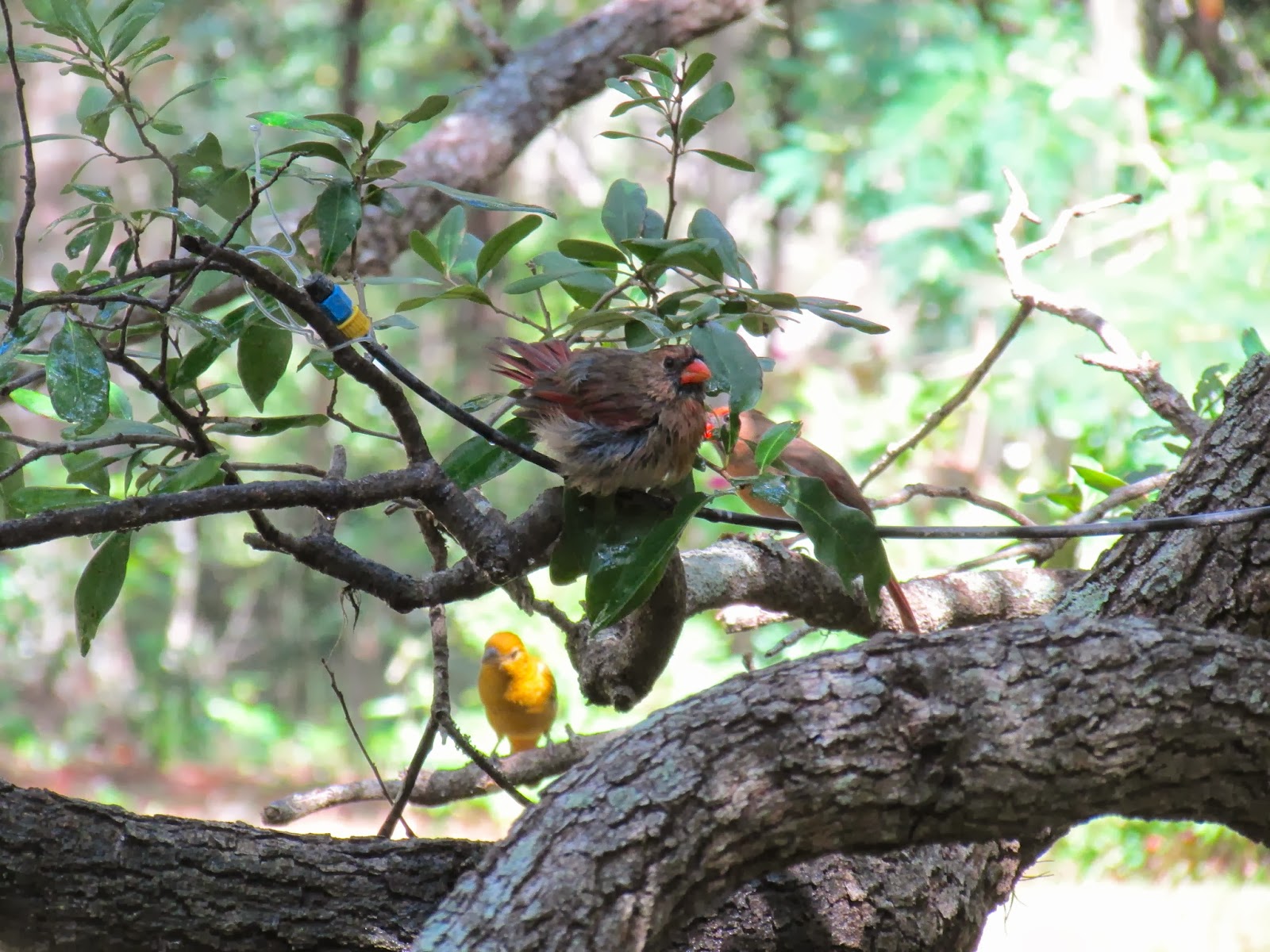
In this configuration, water cascades through the leaves, drips from the branches, and pools on the ground.  I don't know if it's the sight of the water or the sound of it dripping in the pools, but the birds LOVE it.  She can turn on the water, and within minutes there are birds frolicking everywhere.  Here are a few pictures from "The Spa."  In the first, check out the birds in the queue waiting for their turn.  One Cardinal is in the shower, another is just behind, and a Summer Tanager waits patiently:


Eventually, the Tanager got her turn:


Another important aspect of The Spa is that the over-hanging branches and the canopy of the huge oak offer a protected area.  Birdbaths that are in the middle of an open yard may be tempting for birds, but they also expose birds to their predators.  This Pileated Woodpecker (below) seems quite relaxed.


This Swamp Sparrow couldn't find a swamp, but the mud bath seems to be doing the trick.  Click on the photo and look at the large version.  You can see droplets of water on its back.


Meanwhile, a House Finch had moved into the pool.


You want warblers?  Here's a Black-and-White Warbler drinking from the rivulets between the pieces of bark.


And a Northern Parula enjoying a cool shower.


On a recent weekend, the spa also hosted a Chestnut-sided Warbler and a Bay-breasted Warbler.


Of course, when I say ALL birds need water, I mean ALL birds:


Suddenly, there were no other birds to be seen.  But once the Cooper's Hawk left, The Spa reopened for business:


So, folks, if you want to see lots of birds in your yard, use moving, cascading, pooling water.  You'll love the results and you'll be entertained for hours on end by the birds in your own version of The Spa.


Tuesday, October 15, 2013

Yellow Faces and Stinky Places

Hague Dairy - you can smell it before you get there!
There's a Yellow-headed Blackbird in there somewhere!
Birding takes me into all sorts of places.  For every state park, wildlife refuge, and county recreation facility there is a manure-filled pasture, trash-littered roadside creek, or steaming city dump that must be visited.  You see, birds don't care if a place is ugly or if it smells worse than my Aunt Ruth's outhouse.  They go where the food is, and we - the dedicated and somewhat crazed group of true birders - go where the birds go.  And so it was this week that I found myself at Hague Dairy, one of my favorite birding spots in Alachua County and one of the foulest smelling places in Florida.

The word had gone out that a terrific local birder (who happens to be about one-fifth my age) had found two Yellow-headed Blackbirds at the dairy among a flock of grackles, Brown-headed Cowbirds, and European Starlings.  I haven't seen a Yellow-headed Blackbird since since 2005, and it has been longer than that since I've seen one in Alachua County.  Another birder had also found a Bronzed Cowbird, another locally rare goody.  So the Big Red Van made one of its shorter birding runs just a couple of miles down the road to the rural town of Hague and its dairy research facility run by the University of Florida.  There are days when you can smell it well before you actually enter the property.  But it is a rare day when the place isn't teeming with birds.

Yellow-headed Blackbird
The Yellow-headed Blackbird turned out to be fairly easy.  I pulled into the parking lot, went into the office to sign in, came out, and there was one of the birds on an overhead wire.  Before I could snap a photo it flew into a nearby field where it began eating from the cattle food trough.  As you can tell from the photo above, it was too far away for my little camera, so I went back to the car, grabbed my scope, attached my iPhone and waited patiently.  Soon the little beauty stuck its head up.  I focused on the right bird ... and waited some more because its head was down.  Then it popped up and I started snapping.  You can see the results on the left.  Actually, this is the first time I've seen that much yellow on this species, so I was really happy to see it and get a picture.  Success!  Now, on to the Bronzed Cowbird which proved to be not so easy.

Would the real Bronzed Cowbird please identify yourself?
Searching for the one odd bird in a flock of somewhat similar birds is a true exercise in patience.  Imagine staring at a small bowl of identically-shaped rice looking for the one that has one mark that makes it different from the rest.  Now imagine that the rice is constantly moving so you don't know if the piece you're looking at is new to you or the same grain of rice you've examined four previous times.  So you just grind on until you find the gem.  Look at the photo of the birds on the wire at right.  To locate the Bronzed Cowbird, I had to find the one with the red eye.  And every couple of minutes a flock of 30-40 new birds would fly in and land on the wires while some of the ones already there would take off.  Occasionally a raptor would fly over and the whole flock - hundreds of birds - would soar into the air and then land again on the wires.  Each time, I had to start over and methodically work my way through each bird, trying to see its eye with my scope.  And of course there were separate flocks on the ground by the feeding troughs, in the pastures, and on other sets of wires.  Unfortunately, a long and patient search yielded only Brown-headed Cowbirds, Common and Boat-tailed Grackles, House Sparrows, European Starlings, and lots of Rock Pigeons.  But there was more dairy to be seen!

White Ibises with one immature.
Next I headed back to twin pools that constitute a remarkable assault on the senses.  To the best of my knowledge, they fill these things with a mixture of liquids and dung.  They let the liquid evaporate, then haul out the remaining mud to make their own organic fertilizers.  On a good day, the pools are rancid.  On the other hand, sparrows love this stuff.  I even had a Clay-colored Sparrow in there once.  White Ibises love it too, and there is almost always a flock of them hanging out in the area.  I took my bins and stared into the  ... well ... stuff ... hoping to find something good.  However, there were only Palm Warblers and House Sparrows down there.  I guess it was too early for the migrant sparrows.  I also found a House Wren nearby, but he was camera shy, so no picture.  I also sorted through another bunch of cowbirds, but there were no red eyes.

Next I walked out to what we like to call "The Lagoon."  It's another, much larger pool of foul stuff.  I don't know what they do here.  It seems to remain a lake at all times, never being allowed to dry out.  When the liquid levels are low and the season is right, shorebirds LOVE this spot.  Today there was nothing except an alligator that must have no self respect, what with swimming in that waste.  He followed me around as I walked the edges, perhaps hoping that I would come in for a swim.  It would have been a race to see which would kill me first, the gator or the "water".  No thanks.

The walk around The Lagoon produced one unidentified empidonax flycatcher, a couple of Indigo Buntings, a Red-shouldered Hawk, a few vultures, and an Eastern Phoebe feeding in a pasture.  A spot where I have found Painted Buntings in the past has been mowed to the ground, so I don't expect to see one there this year.  Yet another flock of cowbirds held no red eyes among them. I resigned myself to failure on the cowbird front and decided to leave.  Still, hours later the scent of cow manure lingered as if it had gotten ingrained in my nostrils.
I have no clue what this is.  Any guesses?


Swimming in the Swill


An Eastern Phoebe
House Sparrows keeping an eye on me

Friday, September 20, 2013

Two Trips for the Price of One

The River Trail at the Lower Suwannee National Wildlife Refuge
In my never-ending quest to see a migrant -- any migrant -- I visited two counties in the past week.  I spent a day wandering around Levy County in the Lower Suwannee National Wildlife Refuge, Shell Mound, and Cedar Key.  Another day was spent at the Merritt Island National Wildlife Refuge.  While the hoped-for fallout eluded me yet again, both were great birding days.

The Lower Suwannee NWR is in northwest Levy County and it presents an odd paradox for me.  The habitat is just gorgeous.  The River Trail starts in a mixed hardwood forest that gets swampy in the rainy season.  The trail leads to a boardwalk along the watery edge of the river where tall cedars stand like soldiers guarding the banks.  Eventually, it leads through an area of dense underbrush and younger growth.  It should be full of birds.  I've walked it three times over the years.  Once I was swarmed by birds on the first part and saw a few more on the second and third sections.  Twice I've walked it and found very little anywhere.  Then there is the Nature Drive.  It too covers varying habitats from tall pines with a sparse understory made up chiefly of palmetto bushes to dense, deciduous forest.  There are also about a half dozen ponds along the way.  My guess is that the Nature Drive is used primarily by hunters.  There are few if any hiking trails that branch off of the drive and no view of the river at all.  One of the ponds is usually good for a few ducks and waders, the rest are typically devoid of life.  Stopping along the road to spish can be productive at times, but normally it produces only the expected local resident birds.  Bachman's Sparrows can be found near the southern end of the Drive, but otherwise, it has never been terribly productive.  But it should be!  I'll keep trying.

Curiously, there were no cattle to be seen.  Just Cattle Egrets.
As far as the birding day was concerned, it had its moments!  As The Big Red Van approached the park we were struck by the sight of at least 10,000 Cattle Egrets in a single field.  Seriously, that may be an under estimate.  The field itself was at least a quarter mile long and 500 yards deep.  The egrets were in every furrow and on every fence.  The photo on the left shows just one fence along the western edge of the field.  It was truly spectacular.  

A Green Heron in a tree in the woods.  Go figure.
Before turning into the park we stopped and birded the edges of the road.  An Eastern Towhee came out to see what all the fuss was about, but little else, so we drove to the parking lot of the River Trail.  Early on we saw an American Redstart and a Northern Parula.  They were joined almost immediately by a Yellow-throated Warbler, a Black-and-White Warbler, and both White-eyed and Red-eyed Vireos.  A bit later we saw a flycatcher that appeared to me to be an Acadian, and that would be the "default" flycatcher in the park, but it never vocalized, so who knows?  Unfortunately, that was about the last bird we saw on the River Trail.  We then took the Nature Drive.  We added a few typical woodland birds to our day list, but there was nothing unusual until we found a Green Heron perched in a tree above a small puddle of water.  He posed nicely as we snapped a few photos, and was still there when we left.   Our final stop was at the large pond with the observation deck.  However, other than a few Pied-billed Grebes, there was little else there.

Western Sandpiper
Next we drove to Shell Mound near Cedar Key.  On the way in we stopped to examine a small group of Turkey Vultures swirling above us.  We were rewarded when we noted one of them had a mostly white tail -- a Short-tailed Hawk.  This is the third or fourth time we've been fortunate enough to see a Short-tailed in this spot, and it's always a treat.

Unfortunately, the tide was really high and no shorebirds were hanging out in the area, so we headed into town and stopped at Kona Joe's for lunch.  There on the dock behind the restaurant was a Lesser Yellowlegs, a bird I still needed for my Levy year list.  After lunch we decided to make a sweep of the docks on the road to the airport to see if anything interested was perched up or feeding on the shore.  We saw the usual Royal, Forster's and Sandwich Terns, Ruddy Turnstones, Willets, and Semipalmated Plovers.  And there amid the plovers was a single peep - a Western Sandpiper.

Two days later we made the long drive to Merritt Island National Wildlife Refuge where birds thrive in the shadows of NASA's Vehicle Assembly Building and a variety of launch pads; all places that evoke strong memories of my youth and America's space race with Russia.  Even on a birdless day, this would be a great place to visit, but our hopes were high after recent reports of double-digit warbler species.  If you've been reading any of my blogs at all, you'll know that I've been focusing on learning more about shorebirds.  Unfortunately, the shorebird magnet know as Biolab Road was closed for repairs -- in shorebird migration season -- come on, people!  That's not right!  Anyway, we started by taking Blackpoint Drive where there were a lot of Tricolored Herons.  Most of the other waders were present as well as Caspian, Royal and Forster's Terns, some Black-bellied Plovers and a few Dunlin.  A Northern Flicker surprised us as it flew in front of us, and a Belted Kingfisher appeared to take umbrage at our disturbing its morning.

Red-shouldered Hawk
Of course our target for the day was Dummit's Grove and the Oak and Palm Hammock Trails where the warblers had appeared a coupe of days earlier.  There were no birds in the Grove.  I take that back; there was a single Red-bellied Woodpecker.  However, we used its shade to relax and eat a quick lunch before heading to the hammock trails.  The Oak Hammock Trail is the shorter of the two and that's where we started.  It's gorgeous.  I enjoyed the shade of the canopy, basked in the lush greenery, and admired the huge oranges growing wild next to the trail -- descendents of Dummit's orange trees that survived the freeze of 1835 and provided the foundation for Florida's massive orange-growing industry.  We started the walk with a Redstart, a Red-eyed Vireo and a Summer Tanager with a Northern Parula putting in an appearance a bit later.  Then we hit a long dry spell, perhaps the fault of the Red-shouldered Hawk pictured above, right, who seemed very well fed.

Mottled Duck
Just as we reached the end of our walk it started raining fairly hard.  I didn't want to lose another camera to water damage, so I darted under the kiosk at the trailhead.  Thank heavens!  No, not because my camera was now safe ... but as I stood there a small mixed-flock of birds invaded the trees right in front of me.  Here was another Redstart, there a Black-and-White, and over there a Yellow-throated.  Then there was a bird that at first appeared from below to be a Red-eyed Vireo, but that wasn't right at all.  There was more supercilium than eye-stripe, it was too small, and it was acting like a warbler, darting quickly from place to place as it chased, caught and ate bug morsels.  But it was gone a moment later, and I forgot about it for a day.  Then another birder posted a photo of a Swainson's Warbler taken in that same area.  I looked at the photo and thought, "Yep, that's the bird I saw." 

We made a quick stop at the headquarters shop and walked the nearby boardwalk but found nothing new for our day lists.  Our final stop was characterized by a long, bouncy drive along Peacock's Pocket - no doubt named after the many potholes that are more numerous than the eyes in a peacock's tail.  Here we added Yellow Warbler, Glossy and White Ibis, Barn Swallow, Mottled Duck and Blue-winged Teal to our day's haul.  For the day, we scored about 45 species and I was pleasantly surprised to find that I had added eight birds to my Brevard County life list, getting me up to 153.  Then I realized that aside from some pelagic species, nearly all of those birds were seen at Merritt Island, truly one of the nation's best birding hotspots!

A Black Racer at the Merritt Island HQ

A Common Gallinule family

Red-eyed Vireo from Cedar Key

I came so close to walking face first into this!


Friday, September 6, 2013

Touring Jackson County

Blue Grosbeak before the rains came
On Tuesday morning I had a birding day shortened by rain.  To be precise, I was a mile away from my car when the skies opened and dumped a couple of inches of rain on me.  I was soaked inside and out, with water running down my back until it reached my boots.  I was so wet that I decided to take a slow stroll back to the car and enjoy a walk in the rain.  And so a day that started out with some promise (a Yellow-throated Warbler and a Northern Waterthrush) ended quickly.  Things evened out the following day.

The Red Van Gang collected at 4:30 on Wednesday morning and headed north and west toward Jackson County.  After a quick stop in Tallahassee for breakfast, we reached Three Rivers State Park just after 8:00.  But wait ... why were the gates closed?  Oh yeah, we had just entered the Central Time Zone; it was just after 7:00 and the park was closed.  Undeterred, we continued north on River Road and birded the many lakes and ponds in the area.  There were a few Common Gallinules and American Coots.  A couple of Green Herons landed on the bank across from us.  A Double-crested Cormorant swam under the bridge moving from one portion of Lake Seminole to another.  A Belted Kingfisher perched up on a snag.

Apalachee WMA
A bit up the road we saw a sign for the Apalachee Wildlife Management Area.  In the parking lot we met a ranger named Bunting (really!) who was very helpful and very knowledgeable about the local bird life.  He told us where to walk in order to find the pine species we needed for our county lists.  We had good luck from the start.  First we found a Northern Waterthrush working the edges of a large puddle.  Then an Eastern Wood Pewee landed on a perch above us.  One tree over were two Summer Tanagers.  After a bit a Brown-headed Nuthatch came in to check us out.  Farther down the trail we found at least three Bachman's Sparrows.  Eventually we reached a small lake filled with vegetation.  I could hear Common Gallinules calling out, but I couldn't see them.

Bachman's Sparrow
By this time the state park was open.  Our first stop was the area around the campground.  I've heard that there are times when the lake is a haven for ducks, but of course it's too early in the season for that.  We were hoping for a tern, a gull and some waders.  All we found was an Anhinga on the opposite side and a Green Heron on a small island a couple of hundred feet off shore.  In the woods we added a few birds to our day list including a Yellow-throated Warbler, but for a while it seemed we would find nothing special.  Fortunately, just before we left we looked into a tangle of vines in some dense vegetation.  One of our group said, "There should be a prize bird right there."  Instantly, a Worm-eating Warbler popped up at eye level.  I was so surprised I forgot I had a camera and never got a shot of it.  Then it dove into the thickets a few feet away, and we followed it hoping for another look at a terrific bird.  We didn't relocate it, but we did find a Hooded Warbler.

It was getting late and we still had more ground to cover, so we left the park and drove north.  A few more ponds produced mostly an incredible swarm of Love Bugs.  A King Rail called from one pond but never showed itself.  A Wood Duck swam in another before disappearing behind a small island.  Some Wild Turkeys meandered through a field, and some Snowy Egrets waded in yet another pond.  We also checked out two small parks, Parramore Landing and Buena Vista Landing.  Both were beautiful little parks, but we added only one or two birds to our day list.

Buena Vista Landing
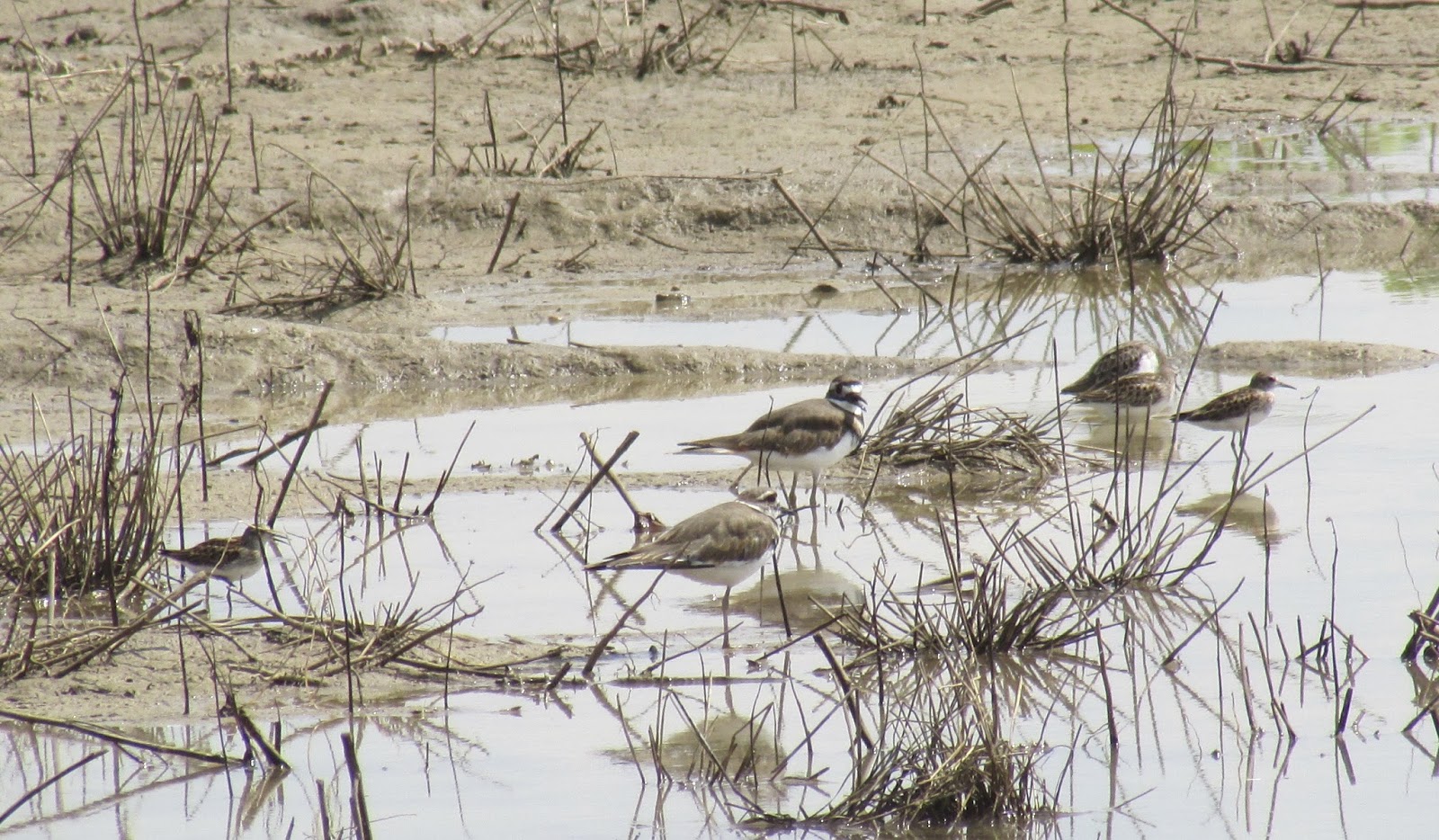
Next we headed for Tower Road.  We had heard that the fish farm located there had a pond that often was very birdy.  We almost missed it, driving right past it the first time.  It's lucky that we did.  There was a shallow pond on the right that had about eight Killdeer and another eight Least Sandpipers.  A u-turn got us back to the fish farm where we added a couple of Blue-winged Teals to our day list.  They were also the first ducks of the season for me, always a cause for celebration.

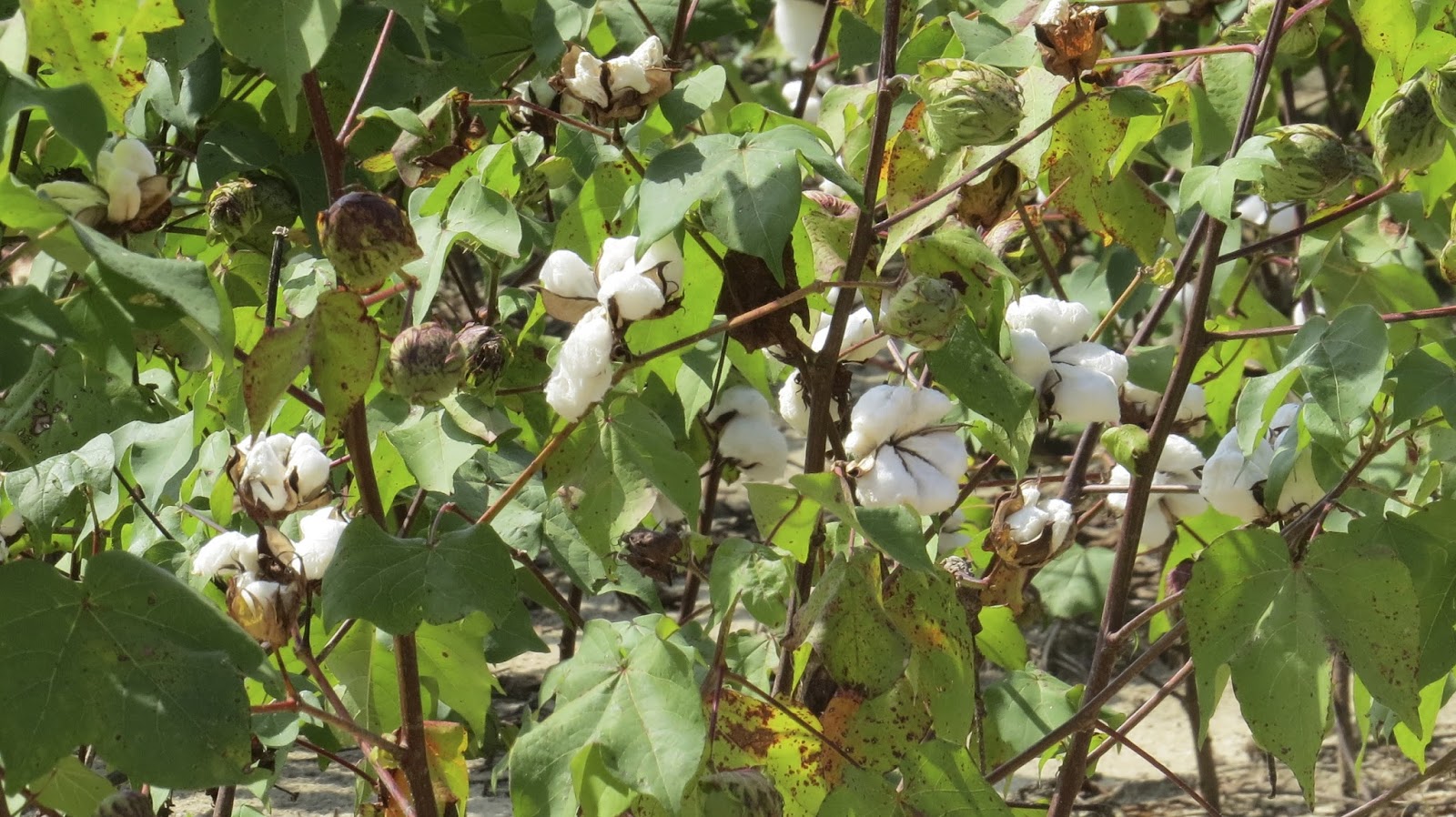
We continued along several small roads passing among huge cotton fields.  There was an Eastern Kingbird in one, but we found little else until we found a farm pond along SR 71.  This produced a great collection of shorebirds: Solitary Sandpiper, Spotted Sandpiper, Lesser Yellowlegs, Killdeer and Least Sandpiper.  Also working the edge was a Glossy Ibis, another "First of the Season" (FOTS) bird.


Least Sandpipers and Killdeer
At that point we decided to call it a day - but the county listing was not quite complete yet.  We stopped at a Hardee's for dinner and found a Chimney Swift flying just east of us.  Then a House Finch landed on the wires directly above the parking lot.  Add two more for the day.  A Eurasian Collared-Dove on the wires in Marianna was the 61st species of the day and the 31st new species for my Jackson County list which grew from 49 to 80.  It was a long day - we left at 4:30 AM and got home at about 8:30 PM - but a great one, filled with birds, friends, and new vistas.  My kind of day!

Lake Seminole
Who says jeans don't grow on ... well ... bushes?
Winner of the 2013 Ugliest Boat-tailed Grackle Contest

Thursday, August 29, 2013

Searching for Warblers

Bolen Bluff Trail as it opens onto Paynes Prairie
The last few days have been busy ones.  I've been out searching for warblers.  After all, this is migration season and the warblers should be coming through.  Others have reported double-digit species counts, so surely I could do better than the single Prairie Warbler I saw at Cedar Key last week.

On Sunday I decided to walk the trail at Bolen Bluff.  This is a well-known fall warbler trap.  Located on the southern rim of Paynes Prairie, the trail runs along the bluff and eventually turns down to the basin itself.  It's a pretty walk and I've had some really great days there with warblers landing in waves, so I had high hopes.  Silly me.  The forest was quiet and the birds absent for nearly all of my walk.  I occasionally heard a Northern Cardinal's chip or a Carolina Wren's booming song, but that was it.  Eventually, I came across a mixed flock and saw a flash of yellow.  I chased after it for a bit and eventually found three Yellow Warblers and a Prairie Warbler.  Yeehaw!  I had doubled my Cedar Key warbler species count! I finished the trail - perhaps about three miles in all - and added two more Yellow Warblers to the day's count.  I've had better days in my back yard.

Northern Parula (Click on the photo to enlarge)
Meanwhile, the internet was all abuzz.  I read Janet Leavens's post about Central Winds Park in Seminole County.  She and others had reported a mixture of warblers including some really nice ones like Blackburnian and Black-throated Blue.  I had never been to Central Winds, but its voice was calling me.  So the Big Red Van headed out on the long drive early on Tuesday morning, and after a very filling IHOP breakfast, we got to the park just after 8:00 AM.

Central Winds is a lovely little park.  Looking at a map, you might think it is way too small to attract a lot of birds.  You would be wrong.  It's a beautiful little patch of green in the midst of urban sprawl on the southern edge of Lake Jessup.  Any birds crossing that lake would look down and see this one attractive bunch of trees and head right for it.  So the park is small enough to bird in a morning, but if the winds are right, there may be birds everywhere you look.

Yellow-throated Warbler
Being unfamiliar with the place, we wandered away from the van looking for a trail to follow.  Instead, we ended up following the birds.  Within 50 feet of the parking lot we encountered the day's first American Redstart, a Yellow-throated Warbler, and a Prothonotary Warbler with a bit of an eye line.  Coincidentally, the same bird was photographed and became the topic of some conversation among the state's birders.  From reading the posts, I learned that a small percentage of Prothonotary Warblers do indeed have a prominent eye line.

Eventually we found the trail and followed it along the rim of a large open field.  We chased a few birds to one corner of the field (near the bleachers) where we encountered another mixed flock.  A few Tufted Titmice and Carolina Wrens were accompanied by a Black-and-White Warbler, another Redstart, and a Prairie Warbler. 

I think Red-eyed Vireos are beautiful!
We saw that the trail was simply going back to the parking lot, so we reversed direction and started toward the lake.  Along the way we met a local birder, Dennis O'Neill, who proved to be very helpful and a really nice guy.  He told us where some of the better birds had been seen the previous day, so we headed in that direction.  A few Northern Parulas and more Prairie Warblers were all that we saw.  The trail ended near the banks of a small pond.  Here were White Ibises, a Little Blue Heron, a Tricolored Heron and a plastic Canada Goose.  There was also a Red-shouldered Hawk swooping and diving around in the skies above the pond.  We walked up the hill and finally came to a stand of oak trees.  There were more Parulas, more Prairies, another Redstart and another Yellow-throated.  It seemed we were finding several small pockets of birds, but they were all the same species.

Again we saw Dennis, and this time he told us of a Yellow Warbler he had just seen back by those bleachers.  We wandered over there and after a bit of work we found another mixed flock.  This time there were Redstarts, Parulas, a Prairie and, finally, a Yellow Warbler.

The Nature Trail at Central Winds Park in Seminole County
At that point I just wanted to sit for a while.  We found a bench and sat for a bit.  Good plan.  Soon another flock flew in and landed above my head!  For a few minutes we were surrounded by Red-eyed Vireos, Titmice, Wrens, Black-and-white and Yellow-throated Warblers, and yet another Redstart.  Red-bellied and Downy Woodpeckers joined in the gang as well.  It's fun being among so many birds, even when they are "the usual suspects."

We wanted to take one more shot at the area under the oaks near the butterfly garden, so we headed back there next.  We exited the trail emerging into the more open area under the trees to find a Red-shouldered Hawk sitting quietly on a low branch.  It kindly posed for several pictures, something I wish that warblers would learn to do.  We looked around for several minutes but the only new bird we saw was a Bald Eagle that circled over us a few times.

For the day we counted 36 species overall, with seven different warblers (and lots of some of them).  Certainly it wasn't a great birding day, but my numbers are heading in the right direction.  From one warbler (Cedar Key), to two (Bolen Bluff) and now seven ... could double digits be just around the next bend of the trail? 

Red-shouldered Hawk looking for lunch
Same Red-shouldered Hawk from the rear
Central Winds Park, Seminole County