Saturday, April 20, 2013

Getting Past Being Spoiled

Great Horned Owl having lunch.
I admit it; I was spoiled.

No, not as a child ... I was spoiled as a birder.  You see, shortly after I became a birder I was present at an incredible fallout of spring migrants in Cedar Key.  It started with several species of swallows, and Rex Rowan, the trip leader saying, "This could be a good sign."  We had warblers crowding the trees at the Shell Mound Campgrounds.  We couldn't get to our parking space at the cemetery because of the warblers hanging from the trees along the entrance road.  There was a Blackpoll here, a Chestnut-sided there, a Magnolia in the next tree north, a Prothonotary in the next tree west, and Black-throated Blues and Greens everywhere.  There were three thrush species in one corner of the cemetery.  There were Orchard and Baltimore Orioles, Summer and Scarlet Tanagers, and Rose-breasted and Blue Grosbeaks all in the same loquat tree.  I had two dozen lifers that day; a day unlike any I have had since then.


Blue Grosbeak
In subsequent years I complained to Rex that I wasn't seeing the number of warbler species I saw in that one day.  He told me to be patient and to look at the numbers.  He said I would usually see about the same number of warbler species from one year to the next.  Wouldn't it be just as good or even better to see a few warblers here and there over the course of six or seven weeks than to see a large number on one day and little else the reast of the season?  I looked at the numbers.  He was right (as usual).


This year, my first year of retirement, I've searched for migrating warblers more often than in several previous years combined.  At first I had no success at all, but gradually I've seen a few good birds here and there.  The numbers are still low, but this week brought some encouragement.  I made three different trips to Cedar Key on April 14, 15 and 17 and led a field trip today, April 20.  Taken together, it wasn't a bad tally.

Gray Kingbird
On the 14th, the winds were still blustery, but not as severe as two days earlier.  We saw our first Gray Kingbird of the season.  We also found a Cape May Warbler and a Black-throated Green Warbler, my first of the latter species in two years.  The loquat trees had a Summer Tanager and a Baltimore Oriole. There was a Yellow-billed Cuckoo at the museum, and an Orchard Oriole still graced the church parking lot. 

We went back the next day hoping the trend would continue.  It did, but in small numbers.  We found a Swainson's Thrush; some Tennessee, Black-and-white and Prairie Warblers; several Indigo Buntings and a few Blue Grosbeaks.  We got a great look at a Great Horned Owl that was lunching on something ... maybe a possum ... high in a pine while a chorus of crows squawked at it.  Later we added a fabulous male American Redstart and finally what I'm certain was a Broad-winged Hawk.

Cape May Warbler
We were back on Wednesday, and our luck continued to grow if somewhat gradually.  We found our first Blackpoll and Black-throated Blue Warblers in the cemetery along with a few Northern Parulas, and Pine, Prairie and Black-and-white Warblers.  Then we found another Tennessee Warbler and my first Chimney Swift of the year. Oh yeah, we also had a great lunch at Kona Joe's - terrific food and friendly service.  Try it!

On each of the day we saw between 40 and 45 species.  A master list would show a total of about 70 species across the three days including about a dozen warbler species.  Not a fallout for sure, but the numbers don't lie.  Migration season is in full swing.  So I'm off to Cedar Key again tomorrow morning.  Maybe I'll find another fallout!

The first bird photo with my new camera!

American Avocet

The view from the back porch at Kona Joe's

Monday, April 15, 2013

Migrating from Fort DeSoto to Cedar Key

This Hooded Warbler was trying to hide from us.
If you're not a birder - meaning that you're one of my family members who reads this out of idle curiosity - you need to know this about those of us who are birders:  We live for migration season.  It's like football season in the south; you wait for it impatiently from the last day of the previous season and can't believe how quickly it's finished.  So while it's here, we spend every minute possible in the field hoping to see those marvelous birds that we can't see here during the rest of the year.  Yes, you can ... and do ... get obsessed.  In previous years my job restricted my birding to weekends, but now being retired means I can indulge this obsession every chance I get.  So since I last wrote a blog entry, I've been to Fort DeSoto once and Cedar Key three times.  I'll do the first two trips here and the second group in a day or two.

Orchard Oriole enjoying some mulberries.
So on my wonderful sister Judy's birthday, the Red Van Gang made the trek to Fort DeSoto.  A quick stop at the ponds in Tierra Verde produced a few Lesser Scaups, a Red-breasted Merganser, and a wonderful aerial display by some Least Terns.  Then we headed into the park and stopped at the park headquarters.  There have been times when I've had trouble getting out of this parking lot because of all the birds.  Not this time.  One Catbird fed in the grass and a Summer Tanager flew in and out of a nearby cedar; that was it.  However, I had heard that there were a few warblers in the East Beach picnic area, so that's where we went next. Quickly we found a gorgeous male Cape May Warbler that provided some great looks but constantly avoided being photographed.  It was joined by a sharp looking male Black-and-White Warbler and a Hooded Warbler that peeked out at us from his hiding place.

Scarlet Tanager
Next we headed to the famous Mulberry tree.  Here there were some really nice birds including the Orchard Oriole pictured above, right and the Scarlet Tanager on the left.  I also saw an Indigo Bunting, a few Catbirds, and a Prothonotary Warbler.  There was nothing new around the fountain, so we decided to try the North Beach picnic area.  We found a few Hooded Warblers, but that was all.  We went to the beach and learned that some teens had just run out to where the shorebirds had collected, shouting and waving at the birds.  Most of them flew off, and so we dipped on the Curlew that had been seen there.  We did see a breeding plumage Common Loon, a few Willets, and a Herring Gull.  With the long drive back to Gainesville, we decided to call it a day.  It wasn't a bad day, but it wasn't the big warbler day we were hoping for.

Sanderlings
Two days later we were in Cedar Key, but it was not a good day for warblers.  The wind whipped out of the southwest, literally pushing us around when we stood near the beach.  The skies were overcast and rain threatened at every moment.  The day started well with some Common Ground Doves and a brief but terrific look at a Seaside Sparrow at the campground near Shell Mound.  There were a few shorebirds at at Shell Mound including several Black-bellied Plovers, Ruddy Turnstones, and some gorgeous American Oystercatchers.

We went into town next.  The public beach had a group of Sanderlings (below, left) that simply flew around the little boy who tried to chase them.  They didn't appear to be impressed by his antics.


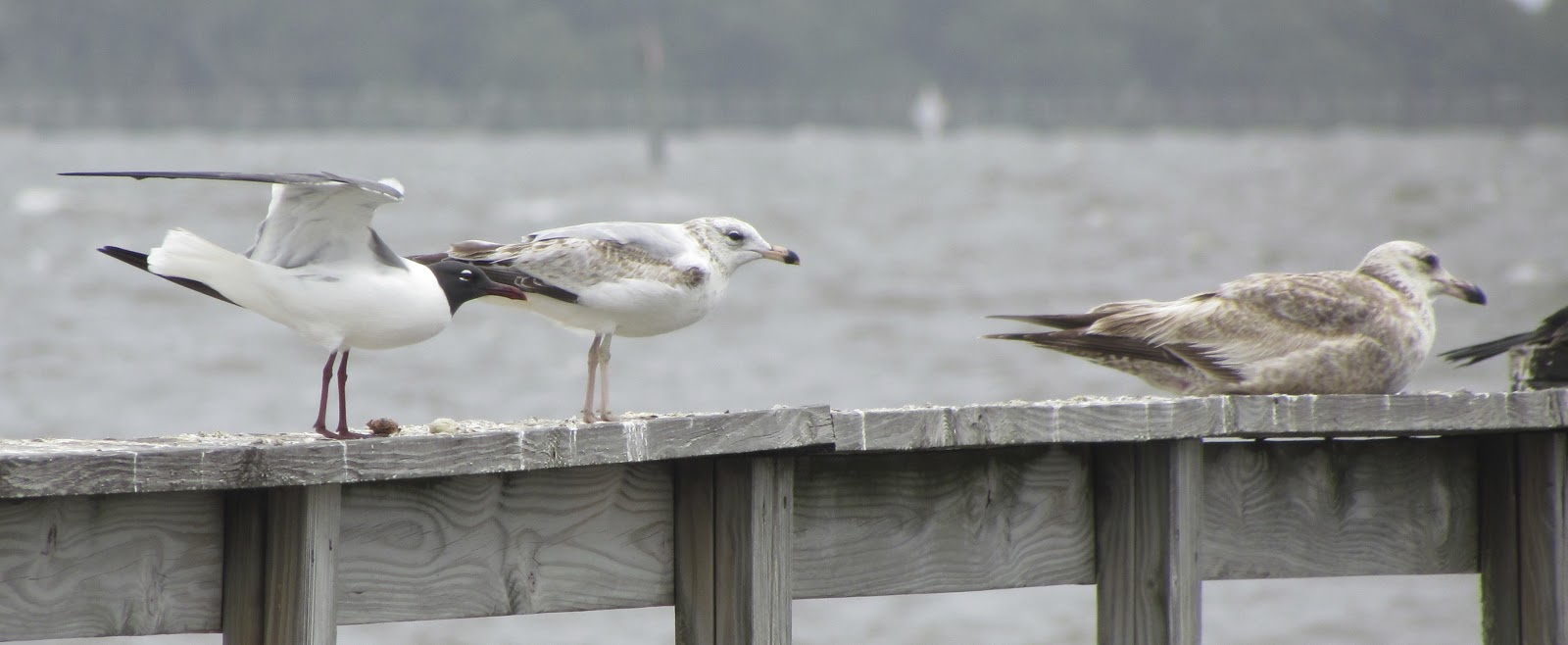
Three gull species hanging out together
Next we headed toward the airport and found two docks overflowing with birds.  On one we found a Laughing Gull, Ring-billed Gull, and Herring Gull standing together.  Before we could take the picture, the Herring Gull sat down, but the comparisons are still there.  On the next dock we saw the group pictured below, left.  There are at least five species in the photo.  Can you find them?  The answer is at the bottom of this report after the final photos.

What are the five species pictured above?  See below.

The weather continued to deteriorate, so we thought we would start home.  The birds did not cooperate.  First we found a delightful Spotted Sandpiper under one of the docks.  In the photo below (left) you can see the spots starting to come in.  Then we found two plovers feeding along the beach.  At first I thought they were two different species since there was such an obvious color difference.  eventually I realized they were both Semipalmated Plovers (below, right), one in breeding plumage and one who still had a pale winter plumage. 

So migration season is here ... but it's like we're still playing the warm up games before the SEC kicks into gear.  Where are the warblers?  Back-to-back trips to Cedar Key on Sunday and Monday found some ... but you'll have to wait a day or two to read about them.

Spotted Sandpiper
Semipalmated Sandpiper
How many species do you see here?


The five species in the dock photo are Ruddy Turnstone, Forster's Tern, Royal Tern, Willet and Short-billed Dowitchers.

The photo of the flying birds has  mostly Sanderlings with a Forster's Tern and at least one Ruddy Turnstone.

Sunday, April 7, 2013

Deja Vu All Over Again

I think this is a Horned Grebe.
Did you ever get the feeling that something that's happening to you right now has also happened to you in the past?  Well, I've heard two explanations ... a glitch in the Matrix (hey, one good movie out of three isn't too bad) or Deja Vu All Over Again (thank you, Yogi).  I have a third explanation: Migration Season!  Whatever the reason, I had that feeling on Friday when for the third time in two weeks I found myself birding in Cedar Key.  Hey, there were two days of winds and storms off the Gulf.  Maybe the migrants would be right behind the front, so let's go birding!!

This time we started by heading right to the Cedar Key Cemetery where we encountered a familiar sight: Florida birding legend John Hintermister, one of the really good guys in the birding community.  John told us to watch the area around where we parked for Red-breasted Nuthatches, and sure enough we found a couple of them.  Then we walked down to the water where we found a Common Loon and a rather untidy bird that we decided was a Horned Grebe.  The day was gloomy and the distance was great, so the photo isn't the best.  I posted it here anyway and invite all of you to tell me if I'm right or wrong by saying something in the comments section below.

Summer Tanager
We followed the shoreline into the grounds of the small park that sits next to the cemetery.  From the boardwalk we had another distant view of a bunch of shorebirds including some American Oystercatchers and Dunlin and a large group of dowitchers huddled together in a big old blob.  Among the group were a couple of birds that grabbed our attention.  After much discussion and later analysis of some grainy and lousy photos that I took, our best guess was that there were several Red Knots in the bunch.  We came to this conclusion based on our impression of the relative size and shape (compared to nearby dowitchers), the presence of some barring along the rear flanks, some black in the tail, and a relatively short, stout bill for a bird of its size.  I may have said this in a previous blog, but shorebirds are hard!! 

John had also told us that his friend Steve Nesbitt had seen an Orchard Oriole at the Episcopal Church in downtown Cedar Key, so we decided to go there next.  Good idea.  By this time the skies were finally clearing and the day was turning gorgeous.  We walked into the parking lot of the church and almost immediately saw several birds in the fruit trees.  One flash of red caught my eye, and I followed it out to a tree along the street.  It was a spectacular Summer Tanager!  My photo doesn't do justice to the breathtaking sight of this bird in good light.

Red-eyed Vireo
Back in the parking lot, things were getting busy! Catbirds and Mockingbirds played tag for a while, joined by a Great-crested Flycatcher followed by a Prothonotary Warbler and an acrobatic Red-eyed Vireo (left).  I would turn one way to look at a bird but then have to spin back the other way for another.  Some Eurasian Collared-Doves landed in a snag high above where they joined some Starlings.  Now, I know that Starlings are introduced and are major annoyances to many.  But did you ever really look at one?  They're actually kind of cool-looking (bottom, right).
Orchard Oriole (Double click on the pic to get a larger view)


Finally the Orchard Oriole made an appearance.  It was a spectacular male.  Or was it a female?  It was both!  This is a bird I just don't see often enough, so getting looks at the male and female in the same tree was a special treat.

Sometimes while birding you see something that's just too cute to overlook.  Among the many birds flying around the church parking lot was a Yellow-bellied Sapsucker.  This little guy must have been munching on an awful lot of berries all morning long because he throat, neck and chest were coated with red berry juice.  Of course we had to take its picture.  That's the one below this report on the left.

Speaking of photos I really like, I had to include the picture of the Great Blue Heron you see at the bottom.  I love those long, graceful feathers blowing in the wind.  I hope you like it too.

As has become our habit of late, our birding day ended at Annie's for a cheeseburger, slaw and corn nuggets.  Good people, good eating, and good birding.  That's my kind of day!

Yellow-bellied Sapsucker with berry stains
European Starling
Great Blue Heron


Wednesday, April 3, 2013

Not So Fast, My Friend!

Barred Owl
When I started this blog I said it would be about birding and my own learning curve.  Yesterday was a good example.  My friends and I had a wonderful day birding in and around Cedar Key with about 65 species and some really terrific bird.  But what I thought was the Bird of the Day was, well, something different.

The day started off really well on SR 24 between Ellzey and Rosewood.  We saw something large fly up from a drainage ditch to the wires above.  Is that an owl?  I pulled off the road, did a U-turn, and drove back to the spot.  Yep, it was a Barred Owl perched on the wires above the shoulder of the highway.  It was nice enough to pose for us long enough to get several photos, including the one you see here.

Florida Scrub Jay
One of the goals for the day was to add a Florida Scrub Jay to our year lists.  We first tried the usual spot in the Cedar Key Scrub Reserve, but this time we had no luck.  Next we tried the area on SR 24 across from the entrance to Waccasassa Bay Preserve.  Again, we failed.  Next we headed out toward Shell Mound on CR 347.  While driving along, we saw a pale bird flying parallel to us.  When it landed, we pulled over to check it out and found two very sociable and cooperative Scrub Jays.  They watched us watch them, and even followed us back to our car.

Feel free to skip this paragraph if you want to avoid one of my rants.  Still with me? OK ... Florida is the only place in the world that this bird can be found.  It's beautiful, curious, intelligent and sociable.  As long as it isn't disturbed, it lives its whole life within a short distance of its birth place.  It will even help its parents build nests in future years.  So why isn't this the state bird of Florida?  I have nothing against Northern Mockingbirds - great singers - but they're everywhere!  The Florida Scrub Jay is here ... and ONLY here.  Our state legislature needs to wake up!

Gull-billed Tern
Soon we reached Shell Mound which is a terrific spot for observing shorebirds.  We weren't disappointed.  There were loads of Dunlin, several Marbled Godwits and Least Sandpipers, a couple of Willets and Black-bellied Plovers,  and more birds to look at on every sandbar.  As I scoped the area, I saw something I had never seen before.  It was a tern of some sort who was nattily attired in a striped cap!  But terns don't have striped heads!  Well, as I was about to learn, yes they do.   After some investigation we realized this was a Gull-billed Tern, a species I have only seen twice before, both times at a distance and on the wing.  Now here was one posing in its not-yet-ready-for-mating-season plumage.  What a great view and what a treat is was to see the bird and be able to study it.  I learned something (not for the last time on this day) about the unusual molting pattern for this species.  Very cool!


Prothonotary Warbler
After my second lunch at Annie's in as many weeks (great burgers, by the way), we headed toward the Cedar Key Cemetery.  At first it appeared to be birdless, but soon we were surrounded by a mixed flock that included my first of the year Great-crested Flycatcher, a fabulous Prothonotary Warbler, and what I believed was a White-breasted Nuthatch!  Wow, was I excited!  White-breasted Nuthatches are few and far between in this area, and I had never seen one in Levy County.  I couldn't wait to get this posted on the Bird Brains listserv.  As Lee Corso might say ... Not so fast, my friend.  After posting my "find" that evening, I learned that my companions disagreed with me.  They remembered seeing a black eye line and white eyebrow indicative of the Red-breasted Nuthatch.  I remembered a white face and a pointy bill, but these are very good birders whose observational powers I respect.  All I can say in my defense is that I saw no red at all on the belly of the bird - just white.  Still, they remembered the thick black eye line, so I quickly posted a retraction.  Lesson learned: Check with the others before posting a "rare find."

It was time to start back toward Gainesville, but it took a while to get out of town.  We had to stop and look at the flock of Black Skimmers and the hundreds of American White Pelicans on the sandbars along SR 24.  As we looked at them, one other bird stood out - a Caspian Tern complete with the rich red-orange of the bill tipped in black.  My photo (below, left) isn't the best, but it's good enough to ID the bird.

Our last objective was to add Burrowing Owl to our year lists, so we made a detour north on CR 337 out of Bronson.  We then took CR 103 to its end and there was the little guy pictured below, right.  That was species #65 for the day and completed a terrific day of birding.

Keep scrolling down for a few "Bonus Photos".  I hope you enjoy them.

Caspian Tern
Burrowing Owl


Marbled Godwit
Florida Scrub Jay (worth another look!)


Forster's Tern (left) and Gull-billed Tern (right)

Tuesday, March 26, 2013

A Little of This and a Little of That

Glossy Ibis (left) and White Ibis
The last five days have been filled with some very successful birding - a bit of it planned, a bit of it unplanned, and all of it successful in one way or another.

It started on Friday morning at Paynes Prairie.  As the gates opened at 8:00, I immediately headed out La Chua Trail.  I hoped to find the White-faced Ibis that had recently been reported to be hanging out near the observation deck.  It's been a couple of winters since I've seen one in Florida, and it's liable to be a couple more.  I did find two gorgeous Glossys which I tried hard to turn into White-faced Ibises, but both had dark eyes.  There were also a few White Ibises in breeding plumage.  Look at the red face and bill of the White Ibis in the photo on the left.  Beautiful!  The Glossy's colors are rich and equally impressive.  A close up of one of the Glossy Ibises is below, right.

Glossy Ibis
However, the real purpose for being at Paynes Prairie was to meet with Tod Eggenberger, a birder from Minnesota who was vacationing in Florida and hoping to add Groove-billed Ani to his life list.  I had met him through Facebook Birders and offered to show him where on the prairie the bird was hiding.  Tod arrived in Gainesville at about 10:30 and we reached the spot shortly thereafter.  The bird was not cooperative.  We carefully searched the blackberry bushes and patiently scanned the tree and bush tops.  No luck.  If nothing else, birding teaches one patience.  An hour later we were still searching.  Then I heard a faint call from the east end of the field.  We walked back that way and in a few moments the Ani popped up to the top of a bush no more than twenty yards away, giving us a clear, unobstructed, and brief view.  Success!  Tod's next goal was a Clapper Rail at Cedar Key.  I suggested an intermediate stop where I had seen a couple of Black-bellied Whistling-Ducks, also a lifer for him (I think). I read later that he was successful with both the Whistling-Ducks and the Clapper Rail.  Congratulations, Tod!!

Western Tanager
On Saturday I had a much more limited objective.  There had been reports of a Western Tanager at a feeder in the front yard of a house near Gainesville.  I set out in a rain storm and soon was parked in a spot from which I had a clear view of the feeders.  After a short while the rain let up and the feeder was inundated by American Goldfinches.  And then there it was, a spectacular male (left).  I had seen a female once before in a yard in Tallahassee.  There's just no comparison.  The male is stunning!

After it flew off, I sat there congratulating myself and then glanced back at the feeder.  What's this?  A female Painted Bunting!  The cameras had already been put away, and the bird flew off after only a moment, but it felt like I had received a really cool bonus.  Seriously, who expects a Western Tanager and a Painted Bunting at the same feeder in a small yard in Florida within a few moments of each other?

Nothing remarkable happened during Sunday's birding and I didn't even get out into the field on Monday, so there was nothing to report.  Then earlier today I spent a very cold morning trying unsuccessfully to get a good photo of a Ruby-throated Hummingbird.  Now I blame this on Alachua County birder Bob Wallace.  He convinced me to add a "Birds Photographed in Florida" category to my County Listing website <www.flcountylisting.com>.  Once I added the category I just had to get serious about taking pictures.  The problem, of course, is that I don't have a decent camera.   This blog had always relied on others for decent photos.  All I have is an iPhone 4S and a great Leica APO Televid 65mm spotting scope. Still, I had reached 99 species on my list and was determined to get #100.   So there I was this morning freezing my backside off with my phone attached to the scope and trained on a feeder some 100 feet away.  The bird showed up numerous times ... on different feeders or on the backside of the target feeder ... but I couldn't get a decent shot.  Finally, I got one usable picture.  It isn't the best (below left), but it's good enough for me to use as my 100th tick on my photo list.

So all of that time and patience paid off in another, less obvious manner.  On the way back to Gainesville I had to stop at the post office in Alachua.  While I stood in the parking lot, a White-winged Dove flew into a tree just above my eye level and no more than 10 yards away.  It stayed still as I got out the scope and phone, attached the eye ring to the phone and the phone to the scope, and then posed for the photo below, right.   A few seconds later it flew away.  If I had been any earlier or later, I wouldn't have gotten the shot.  Sometimes luck is better than expertise!

Ruby-throated Hummingbird
White-winged Dove, #101


Saturday, March 23, 2013

The Birds and Bees among the Birds?

Love among the Swallow-tailed Kites!
A few days ago I wrote about birding through southern Levy County.  On Thursday I went the other direction, driving into the northwest corner of Levy to the Lower Suwannee National Wildlife Refuge.  I had visited this refuge only once before, and that was for a quick drive-through.  This time I wanted to explore the property a bit more thoroughly.  So a couple of Alachua County birders set out early in the morning with the hope of finding a few good birds

Perhaps the best sight of the day came before we actually got into the park.  We were approaching the park from the north on CR 347, about 200 yards from the entrance to Headquarters Road, when we saw a Swallow-tailed Kite drifting over the pines.  It was the first of the year for me, so I pulled over to get a better look.  The Kite was soon joined by a second and they circled the area for a bit, but then one of them landed in a tall pine.  Now, I've never seen a perched Swallow-tailed Kite, so I wanted to get a photo.  As I set up my scope and turned on my iPhone, the second Kite appeared to land on the same branch.  I focused quickly and started snapping away.  It was only after I saw the first picture that I realized what I had.  The Kites were mating!

The River Trail at the Lower Suwannee NWR
We drove into the park and to the headquarters building where we met Ranger Larry Woodward who was both personable and helpful.  We told hm about the mating Kites and he recommended that we walk the River Trail before exploring the Nature Drive.  His recommendations proved to be spot on, and we went on to have a great morning with perfect birding weather.

The River Trail was both birdy and gorgeous.  There was a mixed feeding flock in the parking lot and another about 200 feet down the trail.  Tufted Titmice, Blue-gray Gnatcatchers, and Ruby-crowned Kinglets were joined by three vireo species: Blue-headed, White-eyed and my first of the year Red-eyed.  Next we saw a stunning male Hooded Warbler whose colors were as bright and fresh as could be.  Moments later we caught sight of a Hermit Thrush, which is notable in that it was a county first for me ... after 211 other species!

Hermit Thrush
Eventually we reached the two short boardwalks.  One ran to the southwest to a viewing platform with a great view of the river.  About half-way to the platform we ran across a small flock of American Goldfinches ... county lifer #213.  The second boardwalk ran to the north where it joined a path that led back to the parking lot.  We found nothing new, but it was just beautiful.

Our next destination was the Lower Suwannee Nature Drive, beginning at the north entrance.  One of our objectives for the day was to find a Bachman's Sparrow. Ranger Woodward told us that parts of the park are managed specifically for Bachman's Sparrows, so on several occasions we checked likely spots, but the little critter continued to evade us.  Still, we encountered a few birdy areas and got some great looks at an immature Bald Eagle.  Then we saw a small pond with an observation deck.  We saw several Blue-winged Teals, Pied-billed Grebes, Common Gallinules (does anyone else still want to say Common Moorhen??), and a single Bufflehead.

A Willet feeding in the mud flats at Cedar Key
Soon we reached a spot that was six-tenths of a mile from the southern entrance to the Nature Drive.  There was a large "Prescribed Fire" sign along the road, and behind it a field of pines and palmettos.  We checked it out and there it was ... a lone Bachman's Sparrow, county lifer #214.

It was well after lunch, so we decided to drive into Cedar Key for some food.  We had a nice lunch and then continued birding along SR 24.  We saw a large flock of American White Pelicans, lots of Willets, a few American Avocets, and some White Ibises that had brilliant red face and bills, just in time for mating season.

So for the day we tallied 52 species including three county lifers.  We had great weather, saw some gorgeous new places, and we had a pretty good meal at Annie's.  Makes you feel lucky to be alive!

I've added a few extra pictures below.  I hope you like them.


Immature Bald Eagle
American Avocet


White Ibis

Saturday, March 16, 2013

County Listing in Southern Levy

Eastern Meadowlark
I'm tempted to say I love birding in Levy County.  The truth is, I have done almost all of my Levy County birding in Cedar Key, and nearly all of the 210 species I've seen in the county were either in the Cedar Key area, or they were seen going to or coming from there.  So I decided that I needed to spend some time getting to know the rest of the county.  It was a good decision.  Yesterday was one of those days in which the usual joys of birding were mixed with the distinct pleasure of a beautiful day spent in gorgeous settings.

We started off by heading south on US 41 and stopped at a field outside of Raleigh to check out a Red-tailed Hawk.  The hawk flew away after a minute, but an Eastern Meadowlark announced itself with its gorgeous song in the field right behind us.  In typical Meadowlark fashion, it perched up in the open and posed while I took the picture at left.

Brown-headed Nuthatch


 Next we turned west on CR 326 near Morriston.  As I drove, I saw a little pond just down a hill from the road.  I stopped to check it out, but there was nothing there.  On the other hand, the tree above the car was loaded with birds including  Black-and-White,  Yellow-throated, Pine, and Yellow-rumped Warblers, a Blue-headed Vireo, a Ruby-crowned Kinglet, a Blue-gray Gnatcatcher, and several Tufted Titmice and Carolina Chickadees.  It was really fun being swarmed by birds!

Soon we got onto SR 121 and somewhere along there we pulled off to look for a Brown-headed Nuthatch.  We were successful after just a few a minutes, and we got some nice shots of one that was very cooperative.

Next it was on to Lake Rousseau, west of Inglis.  There is a small park with a boat ramp on the north side of the lake, and the county line moves through the center of the lake.  The park is small, but picturesque.  We saw American Coots, Blue-winged Teal, and Ring-necked Ducks on the water and Great Egrets, Great Blue Herons, and other waders along the edges.

An Anhinga drying its wings.
We continued west on CR 40 through Inglis, heading toward the boat launch west of Yankeetown.  Impulsively, we pulled into a recreation area devoted to flying model airplanes.  We saw a few Greater Scaup and Ring-necked Ducks and the Anhinga pictured at left.   A second photo that shows the gorgeous blue patch around the eye is at the bottom.  I haven't noticed this before, so my guess is that it is associated with mating season.

When we reached the intersection with US 98, we saw a small restaurant on our left.  Above it the sign read "Breakfast Lunch Dinner".  There were so many cars in front of the place that its name was blocked from view.  That in itself was a pretty good recommendation, and I filed it away for later.

Soon we reached the boat launch park and found it to be another really pretty spot.  We watched Laughing and Ring-billed Gulls fly around us, a single Brown Pelican float by, and at least one tern I couldn't ID land on an oyster bar off to the north.  An American Oystercatcher flew from one spot to another, and a Willet fed along one bar directly west of us. 

Waccasassa Park
That brought us to lunch time and we decided to go to "Breakfast Lunch Dinner" back in Inglis.  Good decision again.  The place was still crowded, packed with good ol' boys, many of them wearing camouflage after a morning in the woods.  I had the Captain's Melt, a burger with swiss and grilled onions on buttered and toasted rye.  It was terrific!  The service was prompt and the waitress friendly.  The place is actually called Shrimp's Landing, and I'll definitely go back there the next time I'm in the area.

Next we headed north on 98 to Gulf Hammock where we took 326 west to a little place called Waccasassa Park.  We were three for three on gorgeous places.  This little park had a boat launch and dock and a few picnic tables.  Some locals were fishing along the banks and Red-winged Blackbirds, a Swamp Sparrow, and a Red-bellied Woodpecker darted in and out of the nearby reeds. 

It was getting late, so we turned toward home.  Still, we couldn't resist pulling off at a dirt road leading into the Goethe National Forest for one last look around.  The only bird that showed up was a Yellow-bellied Sapsucker.  Obligingly, he stayed in one spot long enough for us to take a few pictures (below, right).

Overall, it was a gorgeous day with bright sunshine, temperatures that started in the 30s and ended in the 60s, and lots of birds.  We tallied about 60 species.  While none of them were new to the county, much of this part of the county was new to me, so it was time well spent!

Click on the pic and look at the blue!
Yellow-bellied Sapsucker