Saturday, June 4, 2016

Birding North Dakota: Granville

A typical "pothole" in North Dakota, they polka dot nearly the entire middle of the state.


During the planning stage of this trip, I posted a request for birding suggestions on the "North Dakota Birding" Facebook page.  Among the tips I received were several comments along the lines of "Don't neglect the Granville area, especially along 57th Street North."  Accordingly, on Friday morning my friends and I turned east from Minot and eventually found ourselves along a 7-mile rural road through an agricultural area peppered with pothole ponds.

Before I get to the birding part of the day, I'd like to add an aside for my non-North Dakota friends.  During my trip I learned that 90% of the land mass of the state is used for agriculture.  There's also some native prairie left, mostly in national refuges.  So there is very little to prevent the wind from tearing through anything in its path.  To protect their farms, many farmers chose to plant thick rows of trees and shrubs around their homes, barns and other structures. At this time of year, the trees are lush and the lilacs gorgeous.  The photo to the left depicts a really nice example of this practice.  The result provides color and variety to the waves of wheat and other grains rippling in the breeze.

The first field on the western end of the street looked very interesting.  I pulled over and the first thing I saw was a nest high in an oak.  I put the spotting scope on it and saw a Red-tailed Hawk!  Then another flew directly over the nest and began hunting the field in front of me.  Mom tending the home while dad hunted for food?  Whatever the case, it was great seeing that little vignette of domestic life.  I did a slow 360 degree turn and checked out the fields around me.  I saw Killdeer, Robins, a Yellow Warbler, a Ring-necked Pheasant, some Brewer's Blackbirds, an American Goldfinch or two (right) and several Red-winged Blackbirds.  Just another North Dakota farm field.

At the next corner, a Song Sparrow lived up to his name from the top of a pine tree.  A little farther up the road was the first pond and on it were some Mallards and Gadwalls.  Against the far edge were a couple of Blue-winged Teals, and several Northern Shovelers flew in while I watched.  Just another North Dakota farm pond.

Continuing along the road we quickly added Wilson's Snipe, Barn and Tree Swallows, Clay-colored Sparrow, and a gorgeous Northern Pintail (and yes, that's a redundant phrase).  Then I heard a familiar "chin chin chin chin".  I almost overlooked it because it's such a common sound in Florida.  But I stopped to watch the little bird's progress through a small patch of vegetation.  I didn't realize that with all of the many lakes, ponds and potholes I would visit, this would be the only Swamp Sparrow I would see.

Then we heard a very different sound - one that we want to hear desperately in Florida but rarely do.  It was the dry "chibek" of a Least Flycatcher.  At home we see empids and turn away with a shrug.  Here in North Dakota they sing out, identifying themselves to anyone who cares to listen.  What a treat that was ... but not the last of the day.  Each field, pond or copse of trees held something new:  Eastern and Western Kingbirds perching on the same fence.  Orchard Oriole and Lark Sparrow (left) showing off their gaudy plumage.  Sharp-tailed Grouse and Upland Sandpiper feeding in the same field.  Wilson's Phalarope and Green-winged Teal sharing the same pond.  I loved it all.

Near the end of the road I heard another sound that brought me to a stop.  It was a sound I knew, but not because it was familiar.  I had studied it before coming to North Dakota and heard it frequently in Lostwood NWR without ever seeing the bird.  It was the song of a Baird's Sparrow, wasn't it?  I pulled out my iPhone and played the song to check my memory.  The bird popped up just in front of me, took one look at my unimpressive visage, and dove for cover.  Fortunately, the others saw the bird too.  We looked at each other and finally one of us said, "That was a Baird's Sparrow!"  I didn't expect it here along this road, but there it was, a completely unexpected life bird!  After that, the Vesper Sparrow that I saw a few minutes later and a bit farther along the road was a bit of a letdown.

We wrapped up the day with a too-brief stop at the Denbigh Experimental Forest.  In the parking lot I saw an American Robin, a Chipping Sparrow and another Least Flycatcher (right).  We walked along the trail that leads away from the parking area but didn't see or hear a single bird.  Back at the car, I looked longingly down the road that would have to remain unexplored.  It had been a long day, the afternoon was creeping toward the dinner hour, and we had to get back to Minot.  Reluctantly, I hopped in the car and turned to the west.

Sandhill Crane ... and look who's peeking out from the grass on the left!
Wilson's Phalarope ... and I didn't have to take a pelagic trip to see it.
Western Meadowlark greeting the new day.
I love this old barn, especially the cow on the weather vane.
Western Kingbird on one end of a wire.
Eastern Kingbird on the other end of the wire.


Monday, May 30, 2016

Birding North Dakota: Audubon, Lostwood and Des Lacs NWR

Rolling Hills and Pothole Lakes

Yellow-headed Blackbird
I never expected to go to North Dakota.  It wasn't even on my radar as a birding destination.  I knew nothing about the state except that it had part of The Badlands and some oil wells.  That all changed when I talked to a couple of birding colleagues who had birded in the state.  They raved about the birds and told me that ducks were to be found in every pond - and there were a lot of ponds.  That was enough for me.

I studied every bird I thought I might find in North Dakota.  I even looked at Google Maps to see where I had to drive.  But in the end, I really had no idea what to expect about the state itself.  The bottom line is that North Dakota is gorgeous in May!  I loved the rolling hills, the open spaces, and vast expanse of the sky.  And it was very, very green.

The first stop on my trip was Audubon NWR.  As soon as I turned onto the entrance road, there was a small pond to my right, and around it were a group of Yellow-headed Blackbirds (above, right).  I've seen a few of them in Florida, but none of them were quite like this.  It was a spectacular combination of black and gold!  Such a beautiful bird.

Sharp-tailed Grouse
I arrived at the visitor's center just before it was to close, so I walked around for a bit watching the Barn Swallows and Chipping Sparrows, but was a little dismayed to see Starlings in the Purple Martin house.  I hopped back into the car and started the 8-mile Auto Tour.  It was wonderful.  At every turn, ponds and lakes were dotted with ducks and grebes while a variety of swallows and a few terns soared overhead.  I love watching ducks and other water birds, and this was heaven.  It seemed that every pond held a couple of Mallards, a Northern Shoveler, and perhaps a Northern Pintail, Ruddy Duck, or Redhead.  The fence posts held Eastern and Western Kingbirds, while Bobolinks dashed from perch to perch, stopping to sing their bubbly song.   In a very short time I racked up about 40 species.  Unfortunately, the day was growing old and I was getting tired.  I hurried through the last few miles and turned toward Minot and a decent night's sleep after 18 hours of airports, planes, a couple of hours of driving and one beautiful birding hotspot.

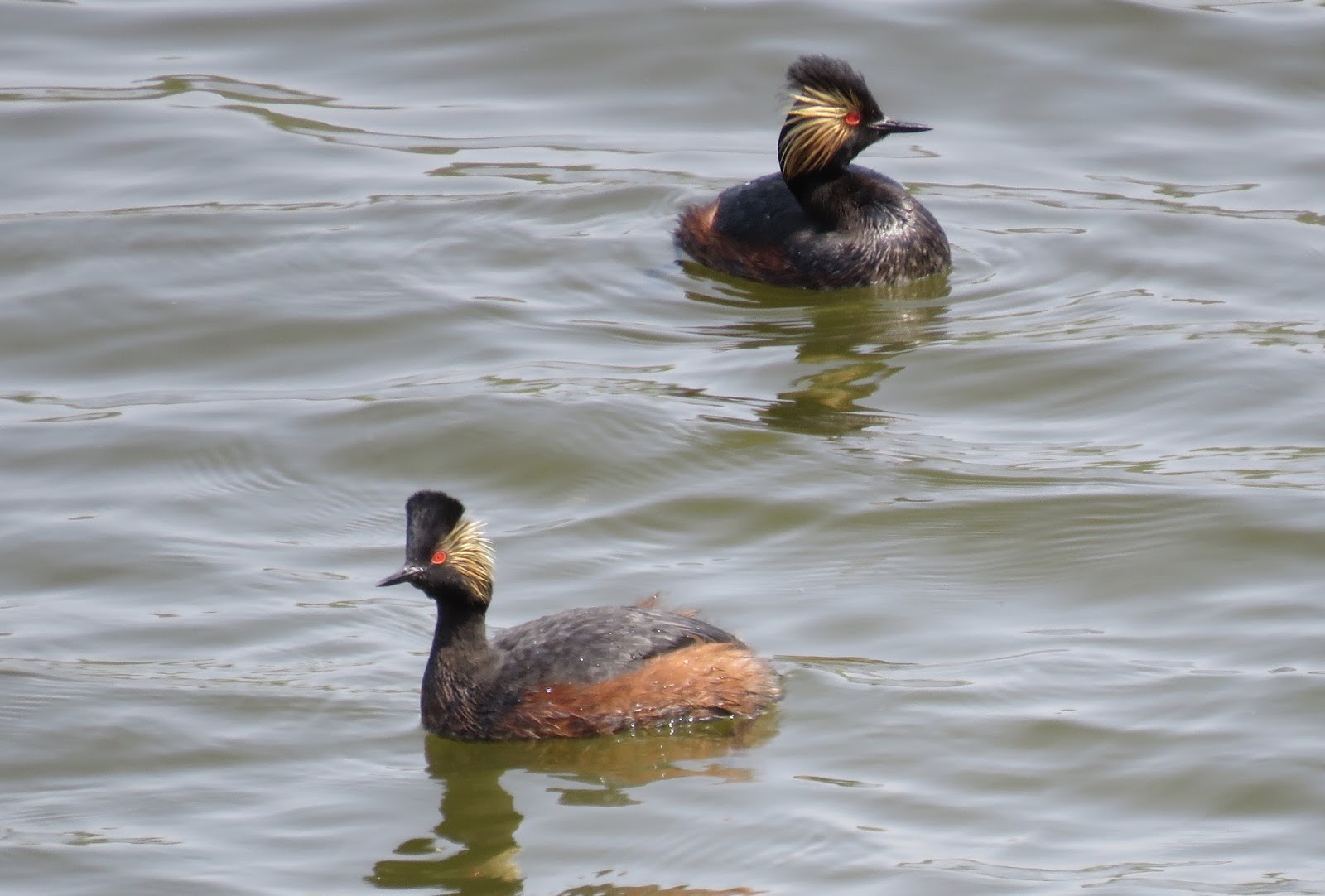
Eared Grebes at Lostwood NWR
I was up at 4:00 the next morning and drove northwest of Minot to Lostwood National Wildlife Refuge.  My plan was to reach the bird blind early enough to see some Sharp-tailed Grouse.  It turned out to be unnecessary.  As soon as I turned onto the auto tour route, there was one sitting up in a tree.  It turned its head to look at me, posed for a few photos (above, left), and ignored me as I drove on.  The first lifer of the trip was as easy as one can be.

Much of the Auto Tour was like the one at Audubon filled with gorgeous ducks and other waterfowl.  And there were some really nice surprises along the way too.  At one stop, a Nelson's Sparrow sang and then came into view.  At another, Wilson's Phalaropes walked the water's edge and swam just offshore.  Another stop offered wonderful looks at Canvasbacks and Redheads.  At a fourth, a Black-crowned Night-Heron flew over.  This was shaping up to be a terrific morning.

But there was a single disappointment.  I heard Baird's Sparrow singing in at least four locations along the Auto Tour.  I won't count a heard-only bird on my life list, so failing to see it was frustrating.  I hoped I'd get another shot at it.

Horned Grebes
Then the real payoff for the day came near the end of the drive.  In Florida, when we see Horned and Eared Grebes, they're a plain black and white ... nothing spectacular.  On the rare occasions when we see Black Terns, they're pretty much like any other tern ... gray and white.  But here all three species were gathered in a single pond in their full breeding plumage, each more stunning than the next.  I stood on the roadside thinking this made the whole trip worthwhile.

My final destination for the day was Des Lacs NWR.  I drove toward the town of Bowbells, crossed Upper Des Lacs Lake, and eventually turned south along its eastern side.  At a small bridge over a little stream, a flock of Cliff Swallows criss-crossed the road in a mad feeding frenzy.  A short while later a couple of Upland Sandpipers appeared on top of a power pole.  American Goldfinches and Yellow Warblers graced the roadside trees.  White Pelicans floated on the lake.  Here a Least Flycatcher vocalized and showed itself; there a Clay-colored Sparrow sat up and sang.

The first two days wrapped up with about 63 species and one life bird.  My goal for this trip was not numbers.  I was after a few lifers and great looks at ducks, grebes and other water birds that I never get to see in breeding plumage.  Undoubtedly, the first two days were a great success.


Gadwall at Audubon NWR
This Ruddy Duck is looking good!
Canada Geese herding the little ones to safety.
Upland Sandpiper fleeing from the paparazzi.
The Auto Tour at Lostwood.
Brewer's Blackbird with nest building on her mind.
Northern Pintail at Audubon NWR


Saturday, February 20, 2016

Bracketed by Owls at Circle B

Circle B Bar Reserve


Great Horned Owl, the first bird of the day.
I don't claim to have had a lot of really good ideas, but there is one that I claim.  Soon after I retired, I decided to start a once-a-month outing for other retired birders.  I also decided to follow the birding with lunch at various restaurants.  My goal was to combine some serious birding with a social occasion.    We have now been meeting for about a year and a half, and I couldn't be happier with the results.  Not only have the monthly field trips become fairly popular, but I've made friends with some terrific people along the way. This past week was a prime example of why I've come to look forward to the Third Thursday of the month.

We gathered at 6:30 on a cool morning and carpooled to Circle B Bar Reserve in Lakeland, about two and a half hours away.  Sally Larson joined the usual Red Van Gang members, Jerry Pruitt took three more with him, and Alachua Audubon president Anne Casella rode with Celeste Shitama.  I always appreciate those who step up and offer to drive and take others with them.  It makes the logistics of a trip so much easier to manage.

Before we even reached the parking lot, we had our first great bird of the day.  We saw a group of birders and photographers staring up into a tree and learned there was a Great Horned Owl nest up there.  Not wanting to disturb the birds, we stayed only a minute.   We saw no adults, but one of the babies was nice enough to peek out at us long enough for us to take a photograph.

Roseate Spoonbill.  I missed this one.
When we got to the parking lot we were greeted by two more of our group who had driven to the park on their own.  Jim and Lillian O'Donnell have become good friends in the last year, largely due to these field trips.  Their northeast Pennsylvania roots don't hurt either!  Jim immediately told me that a Barred Owl was supposed to be roosting along the trail we were taking.  That would be another great bird if we could find it.

First we searched around the education building.  I had heard there was a Painted Bunting in the area, but we failed to find it.  The park was busier that day than I have ever seen it, with the visitor-filled tram running constantly.  Perhaps all of that activity scared the bird away.

We headed out toward the wetland area and walked the narrow path along the berm.  There were birds everywhere we looked.  Early on we saw Limpkin, Bald Eagle, and a nice mix of the usual waders.  We watched an aerial display by a flock of Tree Swallows, and part of the group saw a Roseate Spoonbill that I missed.  One of the group found a Purple Gallinule and a second one wandered into view as we watched the first.

Purple Gallinule
One of the things I like about Circle B is that the habitat invites a great mix of species.  The wetland attracts all of the usual water birds, but the trail is well lined with trees and shrubs that serve as home to a very different set of birds.  So looking one direction produced Green Herons, Snowy Egrets and American Coots, while looking up gave us Blue-gray Gnatcatchers, White-eyed Vireos and a Prairie Warbler.  About midway along the path we saw a lone Black-bellied Whistling-Duck, the only duck species of the day.  That was a surprise, and continued what for me has been the "Year Without Ducks."

The lack of ducks didn't dampen the day at all.  We picked up a Purple Martin among the Tree Swallows.  We watched a Forster's Tern diving for food and a Royal Tern posing like a model for our cameras.  We watched a Gray Catbird dancing on the leaves at the edge of a culvert and a Green Heron with duckweed on his forehead and bill.

Royal Tern
On previous field trips, we always turned right at the end of the long berm and continued through a hardwood hammock back to the parking lot.  Last Thursday we decided to turn left instead.  The morning was nearly finished, so I opted for the shorter loop.  Also, a couple of years ago I found some good sparrows in the grass along the southern edge of the property.  I had no such luck this time.  The sparrows might have been there, but the entire field was cordoned off to protect a tortoise-breeding area.

Eventually we got back to the crossroad where the Barred Owl had been reported.  We had looked earlier, but didn't find it.  This time we got lucky.  Another birder was standing under one tree staring up.  He pointed and said "Barred Owl."  There it was, the 51st and last bird of the day, providing the closing bracket that had opened with a Great Horned Owl chick.

After leaving the Reserve we made our way to Palace Pizza on US 98 in the Publix shopping area.  Eleven of us chowed down on a variety of pizza slices, salads, garlic knots and some raspberry cookies.  I ate way too much and enjoyed every single bite.  I enjoyed the conversation even more which continued during the drive home.  I think we laughed and chatted for the entire 130 miles.

Like I said, I may not have a lot of great ideas, but our Third Thursday Retirees' birding group is definitely one of my better ones.

Snowy Egret

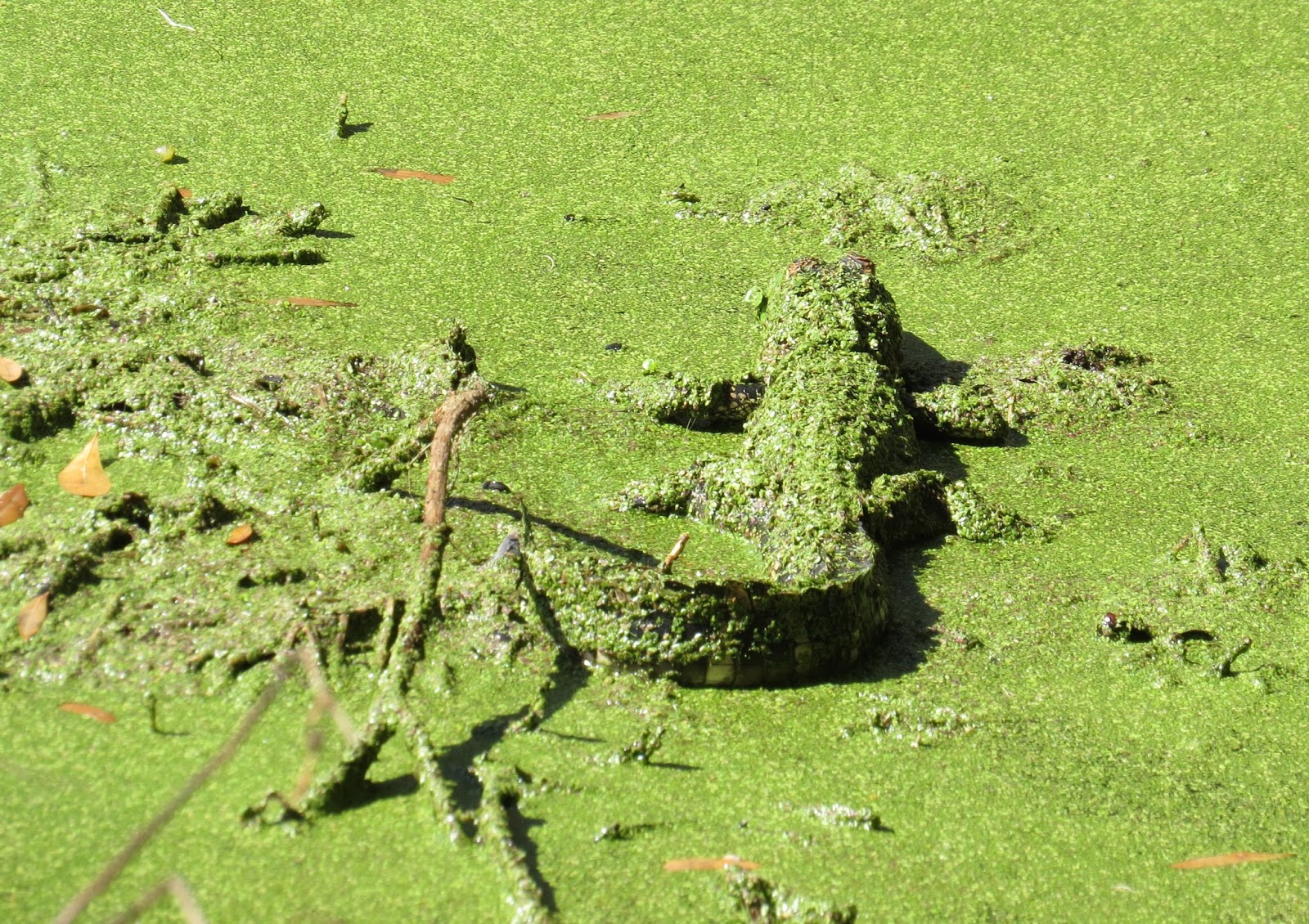
Baby Alligator completely covered with duckweed.

Anhinga drying itself off after diving for its breakfast.


Royal Tern with an interesting hairdo.


Green Heron.  I think this is one of our most beautiful birds.

Barred Owl, the last bird of the day.

Saturday, February 13, 2016

Getting Back to Marion County ... And to Blogging

Lake Kerr

Swamp Sparrow on Black Sink Prairie
There are occasions when time slips by too quickly.  You intend to do something soon, and you don't get to it for a long, long time.  Sometimes there are too many other priorities; sometimes it's just neglect.  Like all of us, I've had a little bit of each, and two examples come to mind.  Last November I published one of these blogs and had loads of ideas for the next essay.  I never got to them.  Who knew that retirement could be so busy?  And years ago - 7? 8? - I visited Black Sink Prairie in Marion County.  It was during a driving rainstorm and I kept saying to myself, "I've gotta get back here soon, maybe in winter when there could be ducks on these ponds."  Didn't happen.  Fortunately, I was able to fix the latter last Thursday, and that gave me the impetus to fix the former lapse as well.

The Big Red Van headed out a little later than usual, and traffic was annoyingly heavy.  Nonetheless, we reached NE 175th Street before the early February air began to warm.  A roadside pond produced a couple of Hooded Mergansers, an Eastern Phoebe and both Great and Little Blue Herons.  It was a good start to what would be a productive day.

I mean no disrespect to the city fathers of Marion County, but I soon ran into something that was really odd.  I wanted to turn south on NE 35th Ave. Rd.  The name's a bit redundant, but finding it should have been easy enough.  I expected to find it nestled between 34th and 36th, or at least a higher number and a lower number.  Not so.  I passed 32nd and then 37th.  No 35th.  I went back ... no 35th, and so I went on.  I passed 47th, 48th and 49th and then found 35th just before 52nd.  Go figure.

Black Sink Prairie
Very quickly I realized why I wanted to come back to this little dirt road.  Both sides are peppered with ponds and stretches of prairie.  One stop produced a nice little mix of birds including a curious Common Yellowthroat, a bunch of frantic Yellow-rumped Warblers, and a Northern Cardinal that was singing proudly from the top of a willow.  A little farther along the road we found a Tufted Titmouse, a noisy House Wren, and a secretive White-eyed Vireo.  Meanwhile, a Northern Harrier glided by looking for a snack.  

Next, a flooded field produced the day's biggest surprise.  I scoped the pond ticking off some Coots, a couple of ducks that I believe were Mottled, a Pied-billed Grebe, and then passed over something that I assumed was a Wilson's Snipe.  But that ID didn't sit well with me.  There were no stripes along the bird's back, the bill looked too long, and the bird looked grayer than I expected.  Also, it walked with a hunch-backed appearance.  I asked my companions to check out the bird, and they agreed that it was a dowitcher, probably a Long-billed Dowitcher, and my only county lifer of the day.

Yellow-rumped Warbler taking flight
We continued through the prairie adding to a growing list of day birds.  There was a Bald Eagle, all of the expected waders including a beautiful Green Heron, Ring-necked and Ruddy Ducks, and some Lesser Scaup.   There were Red-tailed and Red-shouldered Hawks; Chipping, Savannah and Swamp Sparrows, and what seemed to be hundreds of Tree Swallows.

In planning the day, I had hoped to investigate a second road that seemed to run along the western side of the prairie.  That didn't turn out so well.  The road, NE 21st Ave. Rd., was bordered on one side by a railroad track that was on ground that was built up to be higher than the road.  On the other was a series of homes, but no view of the prairie.  Disturbingly, most of the homes prominently displayed "No Trespassing" signs that threatened to KILL violators.  Not prosecute -- KILL.  I'm sorry, but that's not funny and not appropriate.

Florida Scrub-Jay
Anyway, we drove into Fort McCoy, grabbed sandwiches at a Subway, and ate them in the adjoining park.  Then we continued east over CR 316, crossing the Ocklawaha River.  About a quarter mile later we pulled over to look for Scrub-Jays.  As soon as we got out of the van, we saw a Loggerhead Shrike on the wires, my first of the year.  Soon the Scrub-Jays popped up followed by a red-eyed Eastern Towhee.  I love watching Florida Scrub-Jays.  They're smart, curious, active, and gorgeous.  Unfortunately, I've struck out on finding them in the Cedar Key Scrub Reserve for the last two years.  I'm really happy they're easier to find in Ocala.

Our next stop was in the Ocala National Forest at the intersections of FR 88 and CR 314 where we hoped to find a Bachman's Sparrow and a Red-cockaded Woodpecker.  Despite trudging through wire grass and blackberry bushes, we had very little luck.  We saw a few Pine Warblers, Red-headed and Pileated Woodpeckers, but no Red-cockaded.  One bird that I thought might be a Bachman's Sparrow dove from the top of a palmetto bush into the deep grass and disappeared.  It was dark and sparrow-like, and the habitat was correct, but I never saw or heard the bird again.

We tried to find a hiking trail near Salt Springs than led toward Salt Springs Run, but the one we found went in the opposite direction and was birdless.  We abandoned it quickly and decided to go up to the boat launch area on Lake Kerr.  There we capped off the birding day with a Ring-billed Gull, a Boat-tailed Grackle and, finally, two Horned Grebes, the 52nd and last species of the day.  Overall, it was a terrific way to spend a Thursday, and a good reason to get back to blogging.


We missed on the Red-cockaded Woodpecker, but found this Pileated Woodpecker instead.

The view upwards from the floor of the Ocala National Forest

Eastern Towhee - The red eye suggests that this is a migrant.


Wednesday, November 11, 2015

Lake Apopka Wildlife Drive

Red-shouldered Hawk

Eastern Phoebe
About ten years ago I drove to Lust Road near Zellwood to search for a lifer - a Swainson's Hawk that had been reported in the area.  What followed was a great day of birding that included finding the hawk, visiting a kingbird roost and watching Barn Owls set out for their nightly hunt.  But the terrific day had a dark side as well.  Lust Road had a gate across it blocking all traffic.  And while we searched for the hawk, veteran birders told me stories of what it used to be like before the area had been damaged by chemicals that killed massive numbers of birds and other wildlife.  The most frequent phrase I heard was, "This used to be one of the best birding spots in the state."

Hit the fast forward button about nine and a half years.  I was working with the Alachua Audubon field trip committee planning this year's outings.  I thought of Emeralda Marsh, a place I've visited a few times and really enjoyed.  But I knew that access was limited, so I placed a call to the office of the St. Johns River Water Management District.  I learned that a trip to the marsh within the time frame we wanted was impossible.  As I was about to hang up the woman said, "Have you thought about the Lake Apopka Wildlife Drive?"  I knew nothing about it so she said, "You should try it; it's filled with birds."  I decided to take a chance, put it on the schedule, and lead the trip myself.  But I was worried.  When a non-birder says a place is "filled with birds" it could mean anything, right?

The place is filled with birds.

American Bittern
Last Sunday I decided to scout the area since my field trip is just a couple of weeks away.  The Red Van Gang arrived just after 7:00.  At first we had some trouble getting through the gate.  Oh, it was open ... but there were so many birds flying around Lust Road that it took forever to actually reach the gates!  Mourning Doves, Common Ground-Doves, Red-winged Blackbirds, and Common Grackles were present in huge numbers, and some raptors were sorting through them looking for a good breakfast.  A Red-shouldered Hawk patrolled the road, an American Kestrel perched atop a pole behind a building waiting to attack, a Sharp-shinned Hawk dove into a group of doves, and a Merlin settled into a tree top with a meal in its talons.  And one bird rocketed past us, giving us a quick glimpse of something that made me think "Falcon!"  It was really quite a show.

Later, the three of us compared notes on what we saw of that falcon.  After consulting field guides and range maps, we realized it had to be a Peregrine Falcon.  

The canal along the road was also very active.  Anhingas, Great Blue Herons, Little Blue Herons, and Great Egrets were common.  A Belted Kingfisher noisily announced his presence.  Pied-billed Grebes swam with Common Gallinules, completely ignoring me.  An American Bittern hunted on the far edge, freezing in position and lulling his prey into a false sense of security.

Glossy Ibis
We examined several groups of Glossy Ibises but found no White-faced Ibises among them.  A chittering call behind us turned out to be a Marsh Wren who didn't like our presence.  And we may have been among the largest collection of Eastern Phoebes I've ever seen.

Farther down the road we ran into a a group of birders that included Jim Eager, Susan Daughtrey and Paul Huber.  We found a Black-crowned Night-Heron, a White-eyed Vireo, a couple of Swamp Sparrows, and a Tricolored Heron.  Meanwhile, a Northern Harrier coasted just above the marsh looking for food. 

At the pump house, Jim told me to be on the lookout for a Black Skimmer that had been seen in the area.  Almost on cue, the Skimmer flew over the little pond behind the pump house and headed out over the lake.  Jim also told me about three other birds of interest.  He  said White-crowned Sparrows had been seen in the area as had a Peregrine Falcon.  And he noted that a pond nearby had some Fulvous Whistling-Ducks.  At the time, I didn't realize that the raptor we had seen earlier was probably the Peregrine.  We searched for the sparrows, but I didn't find any.  When we left the pump house, Jim took the more eastern route while I drove along the lake.  Jim relocated the Whistling-Ducks and posted a great photo of them online (below).

The lakeside route proved to be a little less productive than I hoped, but perhaps as more ducks fly in, the area will pick up a bit.  However, there were several Ospreys and Red-shouldered Hawks that didn't mind posing for photos. 

Osprey with Lunch
Back on the main road we found Blue-winged Teal on a roadside pond and a Wilson's Snipe flying overhead.  One stop produced a Gray Catbird and a House Wren in the shrubs and a few Savannah Sparrows in the grass.  One bird might have been a Song Sparrow, but I never got close enough to be sure. 

We ended the day at a Beef O'Brady's in Tangerine.  I was taught that if you can't say anything nice about someone or something, don't say anything at all.  Instead, I'll mention that there is a terrific, multiple award-winning novel for adolescents called Tangerine by Edward Bloor set in a fictionalized version of this town.  It was a compelling read, and I highly recommend it rather than the aforementioned restaurant. 

Overall, we had 48 species for the morning and I added eight to my Orange County life list.  I'm really looking forward to bringing a field trip back here in a few weeks.  When I post something on Facebook to advertise the trip, there's one thing I'm confident in saying.

It is filled with birds.

Jim Eager's photo of Fulvous Whistling-Ducks.  Yes, I'm jealous.

Bald Eagle

A Palm Warbler flashing its white outer tail feathers.

Another look at a Glossy Ibis

Osprey

Savannah Sparrow

Blue-winged Teal

This Palm Warbler just needed a good stretch!